Understanding crypto withdrawal risks: the investor's guide

Cryptocurrency withdrawals carry far more complexity than most investors expect. The assumption that moving funds off an exchange is as straightforward as a bank transfer is one of the most costly misconceptions in crypto. Understanding crypto withdrawal risks means confronting a layered reality: irreversible transactions, platform-imposed limits, regulatory freezes, and sophisticated scams that specifically target the withdrawal process. This guide breaks down each risk category with precision, giving you the factual grounding to protect your assets and make confident, informed decisions about where you hold your funds and how you move them.
Table of Contents
- How withdrawal limits and verification impact your access
- Common causes of withdrawal freezes and how to resolve them
- Security mechanisms that protect your withdrawals
- Risks posed by scams, malicious actors, and platform failures
- Best practices for safe and successful withdrawals
- Why investor vigilance outweighs platform promises on withdrawals
- How Crypto Watchdog helps you navigate withdrawal risks safely
- Frequently asked questions
Key Takeaways
| Point | Details |
|---|---|
| Withdrawal limits vary by verification | Your daily crypto withdrawal limits depend on your account verification level and documentation provided. |
| Withdrawal freezes have multiple causes | Freezes can stem from KYC re-checks, regulatory holds, or security alerts and typically require documentation or patience to resolve. |
| Security features protect withdrawals | Two-factor authentication, withdrawal address whitelists, and cooldown periods add crucial protection against unauthorised access. |
| Scams and platform failures pose risks | Beware phishing, scams demanding fees, and risks related to DeFi exploits or exchange insolvency that threaten withdrawal safety. |
| Careful practices reduce errors | Perform test transactions, verify addresses carefully, and expect delays after account changes to ensure safe, successful withdrawals. |
How withdrawal limits and verification impact your access
Having introduced withdrawal risks generally, it is worth clarifying how identity verification protocols directly govern your practical ability to move funds. Most investors discover their limits only when they try to exceed them, which is rarely the ideal moment to learn.
Exchanges structure withdrawal access in tiers, each tied to a specific level of identity verification. At the most basic level, an unverified or minimally verified account may withdraw only small amounts daily, often insufficient for meaningful portfolio management. As you progress through verification tiers, your daily allowance increases substantially. According to Bitget's 2026 withdrawal guide, basic KYC enables daily withdrawals of $2,000 to $10,000 equivalent, while enhanced verification raises that ceiling to $50,000 to $100,000 daily.
The documents typically required at each tier include:
- Basic KYC: Government-issued photo ID (passport or national identity card) and a selfie for liveness verification
- Enhanced KYC: Proof of address dated within 90 days (utility bill or bank statement), plus source of funds documentation for high-value accounts
- Institutional or VIP tier: Corporate registration documents, director identification, and sometimes proof of business activity
One detail that catches investors off guard is the reset timing of withdrawal limits. Most exchanges reset daily limits at 00:00 UTC, not at the time of your first withdrawal. If you initiate a large withdrawal at 23:00 UTC and your limit resets one hour later, you may be able to complete a second transaction sooner than expected. Knowing this is operationally useful when you need to move large sums across multiple days.
Pro Tip: Complete enhanced verification before you need it. Submitting documents during a market event or when you urgently need to move funds introduces delays at precisely the wrong moment. Treat verification as infrastructure, not a formality.
Our withdrawal limits and verification guide covers platform-specific variations in detail, including which exchanges apply stricter limits to specific asset types.
| Verification tier | Typical daily limit | Key documents required |
|---|---|---|
| Unverified | Up to $1,000 | None |
| Basic KYC | $2,000 to $10,000 | Photo ID, selfie |
| Enhanced KYC | $50,000 to $100,000 | ID, proof of address, source of funds |
| Institutional | Negotiated | Corporate documents, director ID |
Common causes of withdrawal freezes and how to resolve them
Understanding withdrawal limits is critical, but freezes pose an even greater obstacle. A frozen withdrawal is not always a sign of wrongdoing on your part, but resolving one requires understanding exactly why it occurred.
There are seven distinct causes we observe repeatedly when reviewing exchange complaints and incident reports:
- KYC re-verification: Exchanges periodically require users to refresh their identity documents, particularly after regulatory updates. This is the most common cause, and KYC re-verification typically resolves within 1 to 5 business days after uploading current documents.
- AML flag: An anti-money laundering (AML) algorithm flags a transaction as suspicious based on size, frequency, or origin of funds. These reviews can take 5 to 30 business days.
- Regulatory hold: A government authority or court order instructs the exchange to freeze specific accounts. Resolution depends entirely on the legal process and is outside the exchange's control.
- Security flag: Unusual login activity, a new device, or a changed IP address triggers an automatic security hold. Usually resolved within 24 to 72 hours after identity confirmation.
- Jurisdiction restrictions: Your account is flagged because your location falls under a newly restricted territory. This can be permanent if the exchange exits your market.
- Exchange insolvency or operational distress: The platform cannot process withdrawals because it lacks sufficient liquidity. This is the most serious scenario.
- Internal investigation: The exchange is investigating your account specifically, often related to suspected policy violations. Timelines are unpredictable.
"Most withdrawal issues stem from regulatory or security holds inevitably imposed and not reversible by exchanges themselves — the exchange is often as constrained as the user." — 2026 Recovery Playbook
When facing a freeze, your escalation path matters. Start with a written support ticket (not live chat, which lacks a paper trail), attach all relevant identity documents proactively, and request a specific case reference number. If the exchange does not respond within the stated resolution window, escalate to the relevant financial regulator in the exchange's jurisdiction. In the UK, that means the Financial Conduct Authority; in the EU, the relevant national competent authority under MiCA.
Pro Tip: Screenshot your withdrawal request confirmation immediately after submission. If a freeze occurs, this timestamp is your primary evidence that the funds were in transit and not voluntarily withheld.
Warning signs of insolvency include sudden withdrawal processing delays across all users (not just your account), vague or scripted support responses, and the exchange restricting withdrawals to specific assets while allowing deposits to continue. Our guide to withdrawal freeze causes documents real cases with resolution timelines.
Security mechanisms that protect your withdrawals
Knowing why withdrawals freeze is vital. Equally important is understanding the safeguards designed to keep your funds secure during the withdrawal process itself.

Exchanges have invested heavily in withdrawal security, and the features available to you are more sophisticated than many investors realise. The challenge is that most of these protections are opt-in, meaning they only work if you activate them.
Key security mechanisms to enable on every account:
- Two-factor authentication (2FA) via authenticator app: Significantly more secure than SMS-based 2FA, which is vulnerable to SIM-swapping attacks. Hardware security keys (such as FIDO2-compatible devices) are the strongest option available.
- Withdrawal address whitelisting: Restricts withdrawals to a pre-approved list of addresses. Any attempt to send funds to a new address requires a separate verification step and a waiting period.
- Anti-phishing codes: A personalised code that appears in all genuine emails from the exchange, making it immediately obvious when a communication is fraudulent.
- Withdrawal PINs: A secondary numeric password required specifically for withdrawal confirmation, separate from your login credentials.
- Cooldown periods: After adding a new withdrawal address or changing security settings, a mandatory waiting period (typically 24 to 48 hours) prevents attackers from immediately exploiting a compromised account.
"Many exchanges implement automatic 24-hour withdrawal locks after password resets or 2FA changes to prevent unauthorised access by attackers who may have obtained your credentials."
One underappreciated concept is the withdrawal protection lock, which some major exchanges offer as a defence against physical coercion (sometimes called a "wrench attack," where someone forces you to transfer funds under duress). This feature allows you to set a secondary passphrase that, when entered, silently delays the withdrawal and alerts a trusted contact or the exchange's security team.
Pro Tip: Never use SMS as your sole 2FA method for a crypto account holding significant value. SIM-swapping fraud is well-documented and specifically targets crypto investors. Migrate to an authenticator app or hardware key today, not after an incident.
Our crypto withdrawal security tips resource provides a step-by-step configuration guide for the most widely used exchanges.
Risks posed by scams, malicious actors, and platform failures
After exploring security features, it is crucial to understand the threats that bypass these protections entirely, whether through social engineering, technical exploits, or platform-level failures.
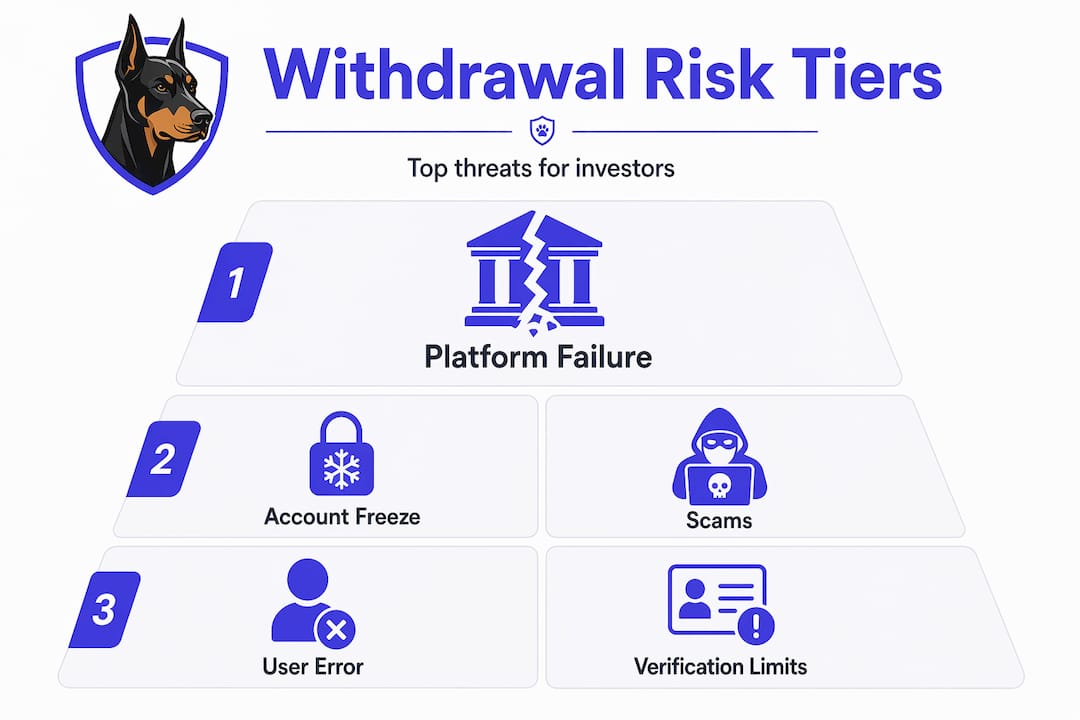
The risks of crypto withdrawals extend well beyond your own account security. External actors and platform vulnerabilities create withdrawal risks that no amount of personal vigilance can fully eliminate.
Scams targeting the withdrawal process follow predictable patterns:
- Recovery scams: Fraudsters contact victims of previous crypto losses, claiming they can recover funds for an upfront fee paid via crypto withdrawal. These are scams targeting victims who are already financially and emotionally vulnerable.
- Fake withdrawal fee requests: Legitimate platforms never require you to pay an external fee to release your own funds. Any request to send crypto to "unlock" a withdrawal is a scam, without exception.
- Phishing sites mimicking exchanges: Convincing replicas of exchange withdrawal pages capture your credentials and redirect funds to attacker-controlled wallets.
- Address poisoning: Attackers send tiny transactions from addresses visually similar to your regular contacts, hoping you copy-paste the wrong address during a future withdrawal.
"Crypto scams cost $17 billion last year, with many schemes specifically pressuring victims to transfer funds to fake platforms that impose fraudulent withdrawal fees as a final extraction mechanism."
Platform-level failures present a different category of risk. The Kelp DAO exploit resulted in $290 million stolen and triggered $9 billion in rapid withdrawals from connected DeFi platforms, demonstrating how a single protocol failure creates contagion across the broader ecosystem. When a major platform is compromised, the rush to withdraw simultaneously can overwhelm processing capacity, delay legitimate withdrawals, and in extreme cases expose users to secondary risks during the chaos.
| Risk type | Primary cause | Reversible? | Typical financial impact |
|---|---|---|---|
| Phishing / social engineering | User error under manipulation | No | Partial to total loss |
| Platform hack | Technical exploit | No | Varies by platform coverage |
| Recovery scam | Emotional exploitation | No | Additional loss on top of original |
| Exchange insolvency | Financial mismanagement | Partial (legal process) | Significant, prolonged |
| Address poisoning | Attacker-seeded address | No | Entire transaction amount |
Our analysis of top DeFi platform risks provides a detailed breakdown of how protocol-level vulnerabilities translate into withdrawal safety concerns for individual investors.
Best practices for safe and successful withdrawals
Having covered risks and threats, the practical question is: what should you actually do before initiating a withdrawal, particularly a large one?
The following checklist reflects what we consider the minimum standard for crypto withdrawal safety:
- Verify your KYC status in advance. Log into your account settings and confirm your verification tier and current daily limit before you need to withdraw. Do not discover a documentation gap mid-transaction.
- Enable withdrawal address whitelisting. Add your destination wallet to the whitelist at least 24 to 48 hours before you plan to withdraw, accounting for the mandatory cooldown period.
- Set up anti-phishing codes and a withdrawal PIN. These take under five minutes to configure and add a meaningful layer of protection against credential theft.
- Use a hardware security key for 2FA. If your exchange supports FIDO2 authentication, use it. The marginal cost of a hardware key is negligible compared to the assets it protects.
- Perform a test transaction first. For any new destination address, send a small test amount and verify receipt before committing the full sum. Malware that swaps clipboard addresses is a documented and active threat.
- Check multiple characters of the destination address. Verify at least the first six and last six characters after pasting. Do not rely solely on a visual scan of the middle portion.
- Plan for security-related delays. If you have recently changed your password or 2FA settings, exchanges auto-freeze withdrawals for 24 to 48 hours as a standard security measure. Factor this into your timing.
- Maintain an emergency recovery kit for self-custody wallets. If you are withdrawing to a hardware wallet or software wallet, ensure your seed phrase is stored securely offline, in at least two separate physical locations.
Pro Tip: For very large withdrawals, consider splitting the transaction across two or three transfers on consecutive days. This reduces the single-point risk of a failed transaction and gives you confirmation of the destination address before committing the full balance.
Our crypto withdrawal safety practices resource expands on each of these steps with exchange-specific instructions and common failure scenarios to avoid.
Why investor vigilance outweighs platform promises on withdrawals
There is a perspective worth stating plainly, even if it is uncomfortable: the security features exchanges advertise are largely designed to protect the platform from liability, not to guarantee your access to funds.
This is not cynicism. It is a structural reality. Exchanges operate under regulatory frameworks that explicitly permit, and in some cases require, them to freeze withdrawals without user consent. An AML flag, a court order, or a regulatory directive can lock your funds for weeks or months, regardless of how compliant your behaviour has been. As the 2026 Recovery Playbook documents, most withdrawal issues stem from regulatory or security holds that are not reversible by the exchange itself, meaning no amount of customer service escalation will accelerate the process.
The security features we outlined earlier, whitelisting, 2FA, cooldown periods, are genuinely useful. But they protect against external attackers, not against the platform itself or the regulatory environment it operates within. This distinction matters enormously for how you structure your holdings.
Our position, grounded in reviewing dozens of platforms through our withdrawal nightmares perspective, is that the phrase "not your keys, not your coins" remains the most accurate single-sentence summary of crypto custody risk. Holding large sums on an exchange means accepting that your access to those funds is conditional, not absolute.
Self-custody via a hardware wallet transfers control back to you, but it also transfers full responsibility. Lost seed phrases, firmware vulnerabilities, and physical theft are real risks that require genuine discipline to manage. The practical answer for most investors is a hybrid approach: keep operational funds on a reputable, well-audited exchange, and move long-term holdings to self-custody once you have the knowledge and infrastructure to do so safely. Complacency in relying solely on platform promises is, in our assessment, the single most common factor in preventable crypto losses.
How Crypto Watchdog helps you navigate withdrawal risks safely
The risks outlined in this guide are not theoretical. They surface in real incidents, on real platforms, affecting real investors who believed their funds were safe.
At Crypto Watchdog, we independently audit crypto exchanges, wallets, DeFi protocols, and trading platforms using an 8-point framework that specifically evaluates withdrawal reliability, security measures, and transparency. Every platform we review receives a trust score out of 100 and a colour-coded alert, giving you an immediate, evidence-based signal before you commit funds. We also publish timely recovery scam alerts when new fraud patterns emerge, so you can recognise threats before they reach you. Whether you are evaluating a new exchange or questioning the safety of your current one, our resources are built to give you the factual grounding to act with confidence.
Frequently asked questions
What are the common reasons my crypto withdrawal might be temporarily frozen?
Common reasons include KYC re-verification requirements, AML transaction flags, security alerts triggered by account changes, jurisdiction restrictions, and exchange solvency issues, each carrying different resolution timelines. According to the 2026 Recovery Playbook, seven typical causes account for the vast majority of freeze incidents reported by exchange users.
How can I minimise the risk of sending crypto to the wrong address during withdrawal?
Always verify multiple characters at both the start and end of your recipient address, perform a small test transaction before sending the full amount, and use address whitelisting features where available to lock in verified destinations.
Why do some exchanges lock withdrawals for 24 hours after security changes?
This automatic lock is a deliberate security measure: exchanges implement 24-hour locks after password resets or 2FA changes to prevent an attacker who has obtained your credentials from immediately draining your account.
Are crypto withdrawals reversible if I make a mistake?
No. Once a crypto transaction is confirmed on the blockchain, it is irreversible, unlike traditional bank transfers where chargebacks or recalls are possible, making address verification essential before you confirm any withdrawal.
What can Crypto Watchdog do to help me stay safe when withdrawing cryptocurrency?
Crypto Watchdog provides independent platform audits, timely scam alerts, and detailed withdrawal safety reviews, giving investors the evidence-based information needed to assess platform reliability and avoid fraudulent or high-risk services before committing funds.
Recommended
- Can't Get Your Crypto Out? A Guide to Withdrawal Nightmares | Crypto Watchdog
- Identify and manage crypto wallet risks for investor safety | Crypto Watchdog
- Understand crypto deposit risks and protect your funds | Crypto Watchdog
- Why Avoid Risky Crypto Services: Protect Your Investments | Crypto Watchdog
Disclaimer
This content is for informational purposes only and does not constitute financial advice. Always do your own research.
Related guides
Crypto performance audits explained: the investor's guide
Learn why understanding crypto performance audits explained is crucial for safeguarding your investments. Gain insights and make informed decisions!
SafetyHow to review crypto platforms safely and avoid scams
Unlock the secrets to safe trading with our comprehensive crypto platform review guide. Learn to spot scams and protect your investments!
SafetyProtect your crypto: spot and report scams with confidence
Learn the crypto scam alert process to spot red flags and report scams effectively. Protect your investments with our essential guide!
EducationUnderstand crypto casino risks: Essential safety insights
Uncover what is a crypto casino risk. Learn essential safety insights to protect your funds and navigate the complexities of crypto gambling.
SafetyUnderstand crypto deposit risks and protect your funds
Learn what are crypto deposit risks and how to protect your funds effectively. Safeguard your investments with practical insights!
SafetyHow to identify and avoid crypto scams: investor guide
Learn what is a crypto scam and how to identify and avoid them. Safeguard your investments with our essential guide on spotting scams today!