How to review crypto platforms safely and avoid scams

Every year, thousands of traders deposit funds into crypto platforms that present polished interfaces, impressive-sounding trust scores, and bold claims of security, only to discover those assurances were hollow. The Trusted Exchange Framework from Coin Metrics exists precisely because the industry needed a quantitative, category-based approach to evaluating exchanges across multiple trustworthiness dimensions. Without a systematic methodology, you are relying on marketing rather than evidence, and in crypto, that gap can cost you everything.
Table of Contents
- What you need before reviewing a crypto platform
- Step-by-step: How to conduct a crypto platform review
- Verification: Ensuring the review's credibility (and your safety))
- Why methodology matters more than trust scores: A safety-first perspective
- Find reliable crypto safety reviews and alerts
- Frequently asked questions
Key Takeaways
| Point | Details |
|---|---|
| Require transparent proof | Only trust platforms that provide verifiable proof-of-reserves and third-party audits. |
| Follow a review checklist | Apply a standardised, step-by-step process to cover all critical safety checks for each platform. |
| Verify scores, not labels | Do not trust opaque trust scores—demand clear methodologies and user-verifiable evidence. |
| Watch for KYC variability | KYC and regulatory controls differ widely between exchanges, so always confirm policies yourself. |
| Ongoing vigilance required | Regularly re-review platforms and stay alert to the latest scam alerts to ensure continued safety. |
What you need before reviewing a crypto platform
With the need for robust evaluation established, let us clarify what you need ready before you begin your review. Approaching a crypto platform assessment without the right tools and mindset is like walking into a contract negotiation without reading the terms. You need structure, verified sources, and a clear understanding of what evidence actually looks like before you start making judgements.
A practical review methodology, as outlined in this crypto risks guide, must combine exchange security auditing practices, proof or verification documentation, and operational risk controls. That means you cannot rely solely on a number displayed on an aggregator site. You need to trace where that number comes from.
Below is a table of essential resources to have ready before you begin:
| Resource | Purpose | Where to find it |
|---|---|---|
| Proof-of-Reserves (PoR) reports | Verify platform solvency | Exchange's dedicated PoR page |
| Third-party audit certificates | Confirm independent security testing | Auditor's public report page |
| Regulatory registration records | Cross-check licensing claims | National regulator databases |
| Merkle-tree inclusion tools | Personally verify your funds are included | Exchange or open-source tools |
| Incident history databases | Assess past security failures | Blockchain data providers |
Before you touch any of those tools, make sure you understand crypto platform transparency as a concept. Transparency is not simply whether a platform publishes a white paper. It means whether the platform can show you, in a verifiable way, that what they claim is actually true.
Here are the foundational warnings to absorb before starting any review:
- Never trust a platform that refuses to publish proof of reserves or incident reports. Silence on these matters is not neutrality; it is a red flag.
- Avoid platforms where the only "evidence" of security is a self-assigned score with no published methodology behind it.
- Do not conflate trading volume with trustworthiness. High liquidity has historically co-existed with catastrophic security failures.
- Treat anonymous or unverifiable team members as a structural risk, not merely a cosmetic concern.
You should also take time to understand understanding trust scores before proceeding, because knowing what a trust score should contain helps you identify when one is being manufactured rather than measured.
Safety warning: Never trust platforms that refuse to publish proof-of-reserves documentation or incident reports. Legitimate platforms have nothing to hide and actively invite independent scrutiny. Absence of verifiable evidence is evidence of risk.
OKX, for example, publishes detailed PoR reports with downloadable artefacts and user-level inclusion verification tools, which is the standard every platform should be held to. That level of openness gives you something to actually test. When a platform cannot or will not replicate that standard, your caution should increase considerably.
Pro Tip: Bookmark the PoR or audit verification pages of any platform you use regularly. When a new report is published (typically monthly or quarterly), you can check your own inclusion in seconds rather than hunting for the page under pressure.
Step-by-step: How to conduct a crypto platform review
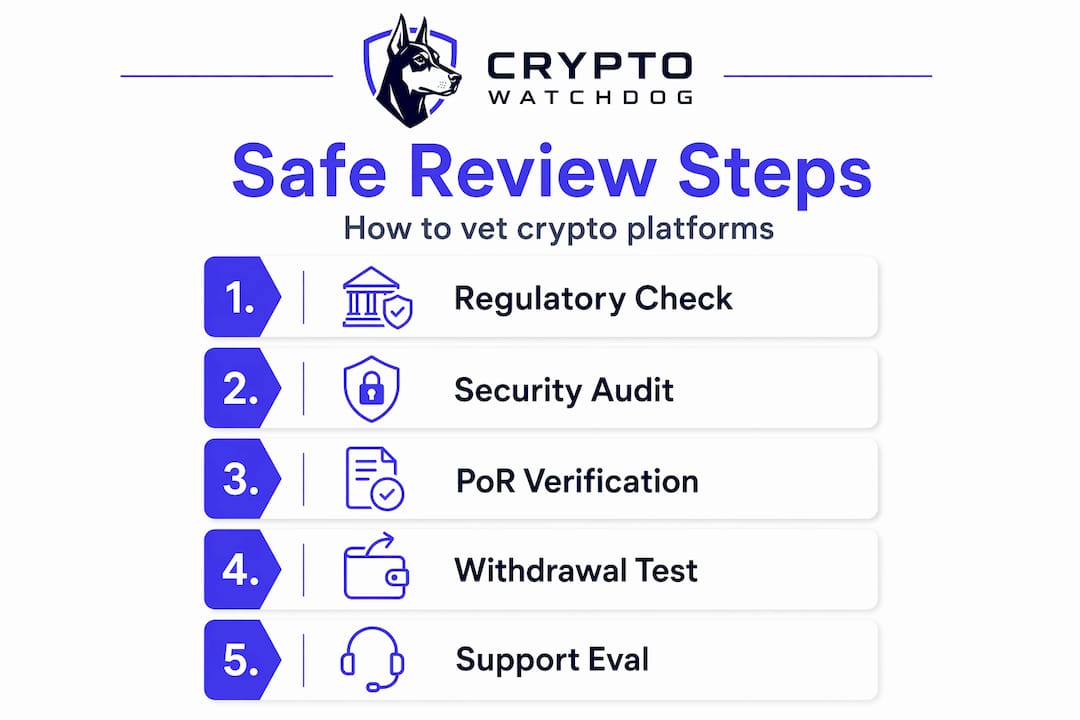
With tools and warnings in place, here is the precise methodology to ensure a thorough and safe review. The following numbered process reflects the stages we use internally at Crypto Watchdog, adapted for individual traders who want to conduct their own due diligence.
1. Start with the regulatory layer. Before looking at anything technical, confirm whether the exchange holds licences in the jurisdictions it claims to operate in. Cross-reference these claims against the relevant national regulator's public register. Unverifiable or outdated licences are an immediate concern.
2. Examine the security architecture. Look for evidence of cold storage practices (ideally 90% or more of funds stored offline), multi-signature wallet controls, and documented incident-response procedures. A platform that has never published a security report, even a brief one, is a platform that has something to obscure.

3. Verify KYC and AML practices. The CoinDesk Exchange Benchmark evaluates 81 spot exchanges across more than 100 metrics and documents significant KYC-policy variability across the sector. Use this kind of benchmark as a reference point when assessing whether a platform's identity-verification requirements meet reasonable professional standards.
4. Test withdrawal functionality. This is a step many reviewers skip. We do not. A platform may accept deposits smoothly but create friction or delays when you attempt to withdraw. Test with a small amount, document the timing and any fees, and compare against published terms.
5. Audit the proof-of-reserves documentation. Do not simply accept that a PoR report exists. Download it. Check the timestamp. Confirm the auditor is a recognised firm rather than an anonymous entity. Then use any provided inclusion tool to verify your own balance appears within the Merkle-tree structure.
6. Score incident history. The Trusted Exchange Framework defines how past incidents should be scored by recency and value lost, and it weights different trustworthiness categories according to exchange type. A spot exchange and a derivatives exchange are not assessed identically, because their risk profiles differ.
7. Evaluate customer support quality. Submit a test query. Note the response time, the accuracy of the answer, and whether the support representative demonstrates genuine knowledge of the platform's policies.
8. Review the team's verifiability. Are founders and key personnel named, with publicly traceable professional histories? Can you independently verify their stated credentials? Anonymous leadership in a regulated financial service is a structural risk, not merely a style preference.
Below is a comparison matrix of three common review approaches and how they differ in reliability:
| Approach | Transparency | Verifiability | Usefulness |
|---|---|---|---|
| Marketing claims | Low | None | Misleading |
| Third-party benchmarks | High | Strong | Very useful |
| Verifiable audit trails | Very high | Complete | Most reliable |
When using a safe crypto exchange checklist in practice, apply these criteria consistently across every platform, not only those you are uncertain about. The most dangerous losses often occur on platforms that appeared credible at first glance.
Pro Tip: When reviewing proof-of-reserves, look specifically for Merkle-tree verification rather than a simple attestation letter. Merkle-tree inclusion checks allow you to confirm that your specific balance is counted within the total reserves, which is materially different from a platform simply claiming that reserves exist.
Understanding platform trust and security as interconnected concepts is essential. A platform might have strong security architecture yet withhold proof that it is operating honestly. Both dimensions must be assessed together.
Verification: Ensuring the review's credibility (and your safety)
After following each review step, it is crucial to ensure the process and evidence can truly be trusted. Completing a review checklist is only valuable if the sources you used and the proofs you examined are themselves legitimate. Cross-verification is the final, non-negotiable layer.
The Trusted Exchange Framework is explicit on this point: prefer sources that expose their mechanics, including scoring categories, weightings, and incident treatment, and enable verification through PoR files, inclusion checks, and named audit partnerships. If a review source cannot tell you how it reaches its conclusions, it cannot be trusted as an input.
Here is a clear breakdown of credibility hallmarks versus red flags:
Credibility hallmarks:
- Published methodology with category weights and scoring formulas
- Downloadable PoR files with user-level inclusion tools
- Named, independently verifiable auditors
- Historical incident disclosures with post-mortem reports
- Regulatory filing cross-references
Red flags:
- Trust scores with no published methodology
- PoR reports signed only by the platform itself
- Anonymous auditors or vague "internal security teams"
- No incident history (statistically implausible for any operating platform)
- Withdrawn or deleted past reports
It is also worth noting a striking data point from the broader sector: KYC-policy variability across spot exchanges is significant, with only approximately 23% of exchanges requiring source-of-funds documentation and around 29% requiring proof of address. This inconsistency means you cannot assume a regulated-looking platform has robust compliance controls. You must verify the specific policies in place.
The approach used by OKX, where Merkle-tree inclusion checks and public verification tooling are available to any user, represents the type of verifiable standard worth requiring. Reviewing exchange security verification practices across a range of platforms reveals just how rare this level of openness remains.
Staying current with latest security incidents is equally important. A platform that passed a review six months ago may have experienced a material security event since. Ongoing monitoring is not optional; it is part of responsible asset management.
Pro Tip: Always search for downloadable proof files or public verification tools. A score label on a website is the beginning of your inquiry, not the end. If you cannot independently confirm the underlying data, treat the score as unverified.
Why methodology matters more than trust scores: A safety-first perspective
The most dangerous idea circulating in crypto retail circles right now is that a single number, a trust score out of 100, can reliably tell you whether a platform is safe. We understand why that idea is appealing. It is simple. It saves time. It feels authoritative. But in our experience reviewing dozens of platforms across exchanges, wallets, DeFi protocols, and trading bots, opaque trust scores have proven to be among the most misleading signals in the space.
The collapses that devastated retail investors in recent industry cycles share a common thread: platforms that carried strong aggregate scores from various aggregators right up until the point of failure. Those scores were built on self-reported data, unverified claims, and volume metrics that had no bearing on solvency or custody practices. The score was real; the trustworthiness was not.
As the Trusted Exchange Framework states plainly, when using any exchange review or safety ranking, you should prefer sources that expose their mechanics rather than relying on opaque trust scores. This is not a minor preference. It is the core principle that separates analysis from advertising.
We hold ourselves to this standard at Crypto Watchdog. Our 8-point audit framework is published. Our scoring methodology is explained. When we conduct live deposit and withdrawal tests, we document what we did, what happened, and what it means. The point is not to produce a convincing number; the point is to create evidence that you can interrogate.
What we encourage every reader to internalise is a "distrust-by-default" posture. This does not mean treating all platforms as scams. It means requiring that trust be earned through verifiable evidence rather than claimed through marketing. A platform willing to publish its proof of reserves, submit to independent auditing, name its leadership, and document its incident history is demonstrating something that a score alone cannot: a willingness to be held accountable.
The discomfort of that posture is worth it. The alternative, extending trust based on surface signals, is precisely how thousands of investors have found themselves locked out of accounts or watching their balances disappear. When you apply a rigorous process, you are not being sceptical for its own sake. You are being professional. And in a market with this many structural risks, that professionalism is your primary defence.
Understanding platform trust as something to be verified rather than assumed is the most important mindset shift this guide can offer you.
Find reliable crypto safety reviews and alerts
To maintain security long term, make ongoing use of trusted expert resources and intelligence. Conducting a one-off review of a platform is valuable, but the crypto sector moves rapidly. New vulnerabilities emerge, team structures change, and platforms that were credible six months ago may have deteriorated in ways that are not immediately obvious.
At Crypto Watchdog, we publish independently conducted platform audits, live-test findings, and fraud alerts on a continuous basis. Our latest scam alerts are updated as new risks are identified, giving you current intelligence rather than outdated assessments. For traders who want to build deeper knowledge across security, verification, and risk management, our education centre provides structured, evidence-based content designed specifically for active crypto users. You do not have to navigate this alone, and you should not have to rely on marketing to stay safe.
Frequently asked questions
What is proof-of-reserves (PoR) and why is it crucial for crypto platform reviews?
Proof-of-reserves is a verifiable audit demonstrating that a platform holds sufficient assets to cover all user balances. It is crucial because, as shown by OKX's public PoR programme, user-level inclusion verification provides concrete evidence of solvency that self-reported claims simply cannot match.
How do I check if a crypto exchange is trustworthy?
Look for transparent proof-of-reserves, named third-party auditors, clear scoring methodology, regulatory registration, and user-verifiable inclusion tools. A solid review methodology combines security auditing, proof verification, and operational risk assessment rather than relying on any single metric.
Do all crypto exchanges require KYC verification?
No, KYC requirements vary considerably across the sector. CoinDesk's Exchange Benchmark reports that only around 23% of spot exchanges require source-of-funds documentation and approximately 29% require proof of address, meaning you cannot assume compliance rigour from appearance alone.
What are common red flags when reviewing crypto platforms?
Missing or unverifiable proof-of-reserves, opaque trust scores with no published methodology, absent audit trails, and inconsistent regulatory disclosures are all key warning signs. As the Trusted Exchange Framework advises, always prefer review sources that expose their scoring mechanics over those that produce scores without explanation.
How often should I repeat safety reviews for platforms I use?
Conduct a structured review at least once per quarter and immediately following any reported major incident or exploit affecting the platform or a close competitor. Security conditions in crypto change faster than most traditional financial sectors, and a review from even three months ago may no longer reflect current conditions.
Recommended
Disclaimer
This content is for informational purposes only and does not constitute financial advice. Always do your own research.
Related guides
Protect your crypto: spot and report scams with confidence
Learn the crypto scam alert process to spot red flags and report scams effectively. Protect your investments with our essential guide!
SafetyHow to verify crypto wallet safety and avoid scams
Learn how to verify crypto wallet safety and avoid scams with our step-by-step guide, ensuring your investments are well-protected.
SafetyHow to identify and avoid crypto scams: investor guide
Learn what is a crypto scam and how to identify and avoid them. Safeguard your investments with our essential guide on spotting scams today!
SafetyWhy Avoid Risky Crypto Services: Protect Your Investments
Discover why risky crypto services cost investors millions and how to protect your funds with evidence-based checks before trusting any platform.
SafetyUnderstand crypto deposit risks and protect your funds
Learn what are crypto deposit risks and how to protect your funds effectively. Safeguard your investments with practical insights!
SafetyYour Crypto Is Not Safe: Why Two-Factor Authentication Is Non-Negotiable
A password alone cannot protect your crypto. This evidence-led guide explains how 2FA works, why SMS codes are the weakest option, and how authenticator apps and hardware security keys give you phishing-resistant protection you can set up today.