Why Avoid Risky Crypto Services: Protect Your Investments

By Danny Allan
Founder & lead analyst, CryptoWatchdog · former Complaints Manager at Crypto.com
20 April 2026· Updated 18 June 2026
A slick app and a confident promise of returns tell you almost nothing about whether your money is safe. We have audited enough platforms to say that plainly. The interface is the part the operators control most easily, so it is the last thing you should trust.
What actually matters is what sits behind the screen: who holds the keys, who checks the books, and what happens to you if the whole thing goes wrong. On a lot of unregulated services the answer to all three is grim. No consumer protection. No meaningful recourse if a dispute goes against you. You are on your own, and you usually find out at the worst possible moment.
QuadrigaCX and FTX were not freak accidents. They failed in ways that regulators and independent auditors had warned about for years. The structures that brought them down were visible to anyone who knew where to look, which is the uncomfortable part.
This guide leans on documented cases, regulatory warnings, and our own 8-point audit methodology. The goal is simple: help you recognise the risky crypto services most likely to cost you everything, before you hand them a penny.
Key takeaways
| Point | Details |
|---|---|
| Unregulated platforms make losses permanent | With no consumer protection behind them, money lost on unregulated crypto services is usually gone for good. |
| Scams breed where nobody is watching | Fraud, Ponzi schemes and exit scams cluster on platforms with no regulatory checks and no audits. |
| Regulation lowers risk, it does not delete it | Oversight adds real safeguards, but volatility and untested products mean some risk always stays on the table. |
| Doing the homework genuinely pays off | A few minutes checking a platform's background and warning history sharply cuts your odds of being caught out. |
What makes a crypto service risky?
No two crypto platforms are built alike, and the distance between a properly regulated exchange and a predatory one is often invisible until your withdrawal stops going through.
Strip it back and a risky crypto service is any platform running without real external oversight, without transparent ownership, or without the basic financial safeguards that keep your money separate from the operators' money. Those three things sound dry. They are also the difference between getting your funds back and watching them vanish.
The most reliable way to read structural risk is to look at what a platform is missing, not what it advertises. Unregulated platforms tend to skip KYC (Know Your Customer) and AML (Anti-Money Laundering) controls, independent custody audits, and any clear rule for how user funds are held. In plain terms: nobody is checking that the money you deposited is still there.
Those gaps are not paperwork that someone forgot to file. They are the exact conditions that let insiders commit fraud, manipulate markets, and walk off with deposits. Remove the checks and you remove the friction that would otherwise stop them.
Two cases make the point better than any warning could. QuadrigaCX ran with a single person holding all the private keys. One man, sole custody of customer funds, no independent verification, no backup. When he was gone, so was the access. FTX built itself around FTT, a token it issued itself and then leaned on as collateral. The exchange's apparent solvency depended on the price of an asset it controlled, which is the financial equivalent of valuing your house using a number you wrote on a sticky note.
Both setups would have failed basic regulatory scrutiny in an afternoon. Millions of people trusted them anyway, because they looked professional and well funded. Looking the part is cheap.
Here is how regulated and unregulated platforms tend to stack up:
| Feature | Regulated platform | Unregulated platform |
|---|---|---|
| KYC/AML compliance | Required | Often absent |
| Independent custody audit | Mandatory | Rare or non-existent |
| Transparent ownership | Disclosed | Frequently obscured |
| User fund segregation | Enforced | Not guaranteed |
| Regulatory oversight | Active | None |
The traits worth watching for:
- No verifiable team or company registration behind the platform
- Absence of third-party audits covering reserves or smart contracts
- Self-issued tokens used as primary collateral or liquidity
- No clear withdrawal policy or evidence of withdrawal testing
- Vague or missing terms of service with no dispute resolution pathway
If you want a structured way to score any platform against these criteria, our methodology overview lays out the framework, and you can browse verified platform reviews where every service is measured the same way.
The price of risk: real-world outcomes
Knowing the warning signs is one thing. Seeing the bill is another. The numbers below are not abstractions. Each one represents people who put real savings into a platform that failed them, and who mostly never saw that money again.
The most thoroughly documented case is still QuadrigaCX. The Ontario Securities Commission concluded that the QuadrigaCX fraud led to $215 million in losses across 76,000 users, driven by fraudulent trading and the misappropriation of customer deposits.
Those users had nothing to fall back on. No compensation scheme. No ombudsman to call. No legal route that could realistically claw the money back. That is what "no recourse" looks like when it stops being a phrase and starts being your account balance.

FTX's collapse in November 2022 was larger again, erasing billions in user assets within days. The speed is the lesson here. A platform built on structural weaknesses can hold together for years and then come apart in a long weekend, the moment confidence cracks.
| Platform | Year of collapse | Estimated user losses | Users affected |
|---|---|---|---|
| QuadrigaCX | 2019 | $215 million | 76,000 |
| FTX | 2022 | $8+ billion | Millions globally |
| Celsius Network | 2022 | $4.7 billion | 1.7 million |
"Investors in crypto-assets should be prepared to lose all the money they put in." That is not buried in a terms-of-service footnote. It is a formal warning from ESMA and European supervisory authorities, written for ordinary consumers. When the regulators put it that bluntly, it is worth reading twice.
The collapses follow a pattern you can almost set your watch by:
- The platform holds user funds with opaque or single-point custody, so no outsider can confirm the money is really there.
- Internal controls are absent, leaving deposits free to be used for proprietary trading or personal spending.
- Withdrawals start to strain liquidity, and the gap between reported reserves and actual reserves comes into view.
- Confidence collapses fast, and a run begins that the platform cannot survive.
- Users are left with nothing to claim against, because no regulator, compensation fund or ombudsman stands behind the loss.
If you want a structured way to pressure-test a platform against this sequence, our guide on what to do when an exchange fails walks through it, and you can follow the latest exchange security incidents to watch the same patterns repeat in real time.
Hidden traps: scams, fraud and Ponzi schemes
Collapses make the headlines. The quieter damage happens daily, on platforms where active scams drain funds before the victim has any idea something is wrong.
Unregulated services are ideal ground for this. No authority is monitoring activity, no audit trail has to be kept, and nobody holds an operator accountable once they vanish with the money. Take away every guardrail and the predictable thing happens.
The FCA has been direct about it, warning that unregulated firms carry a heightened risk of scams, fraud and Ponzi schemes, and that if things go wrong you have no access to the Financial Ombudsman Service or the Financial Services Compensation Scheme. No safety net, by design.
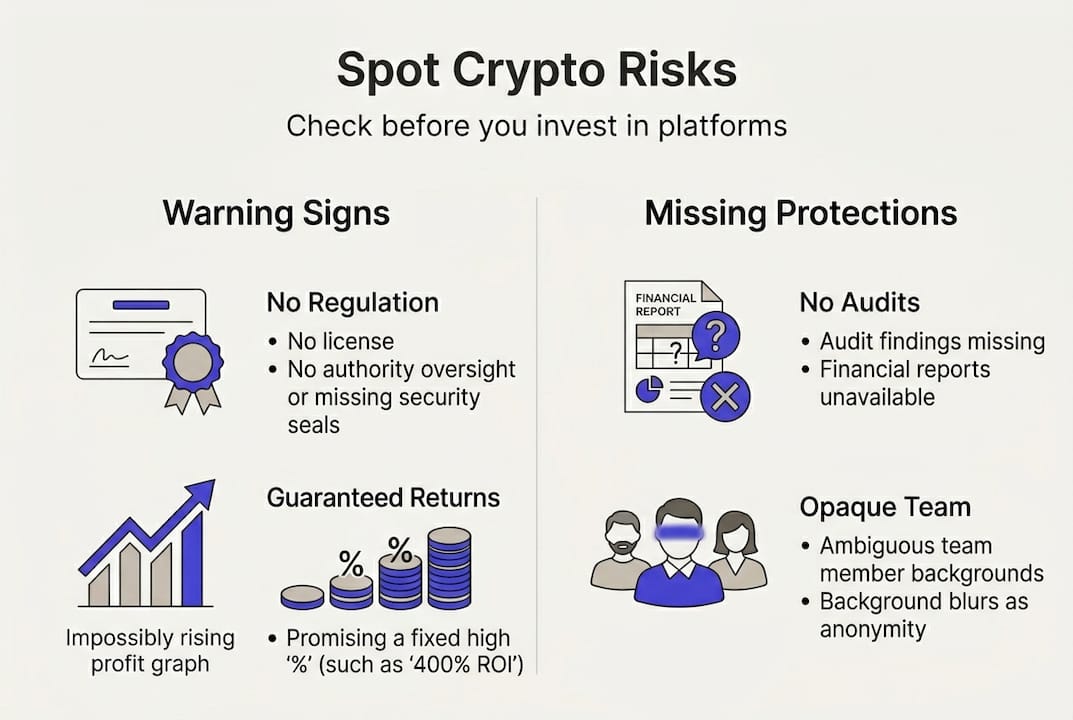
The tells of a scam or Ponzi platform:
- Promised or fixed returns no matter what the market does
- Pressure to recruit other investors before you can unlock earnings
- Urgency tactics like limited-time offers and countdown timers
- Unverifiable celebrity endorsements or testimonials that lead nowhere
- No clear explanation of how the returns are actually generated
- Withdrawal restrictions that only surface after you have deposited
Three fraud types show up again and again beyond the classic Ponzi. Recovery scams prey on people who have already lost money, posing as recovery agents who take an upfront fee and then disappear. It is a cruel one, and it works because the victims are desperate. Rug pulls happen when the developers of a new token or DeFi protocol drain the liquidity once enough deposits have rolled in, leaving holders with something worthless. Fake airdrops lure users into connecting their wallets to a malicious contract, which then hands the attacker the keys to everything inside.
Learning to read these patterns before you engage with a platform is one of the most practical defences you have. Our scam-spotting guides work through the warning signs in detail, and the current platform warnings database shows which services have already been flagged.
Pro tip: Before you touch a new crypto service, search its name next to "scam," "warning," and "FCA" or your own regulator's name. Warning databases get updated often, and they routinely flag platforms weeks before the wider public catches on. Two minutes of searching has saved a lot of people a lot of money.
Why regulation matters, and where it stops
With failures and scams this common, the natural next question is what regulation actually buys you. The honest answer: a great deal, but not everything. Both halves of that sentence matter.
The protections are concrete. A regulated platform has to keep user funds separate from its own operating cash, submit to regular audits, run AML and KYC controls, and operate knowing its licence can be pulled if it breaches the rules. Users of regulated services usually have a financial ombudsman to turn to for disputes, and in some jurisdictions a compensation scheme that covers losses up to a set limit. None of that exists in the unregulated world.
But here is the part the marketing tends to skip. EU supervisory authorities have warned outright that total loss is still possible inside a regulated framework, and that certain crypto-assets carry risks with limited protection no matter how well regulated the platform offering them is.
Volatility, speculation and the sheer novelty of many crypto products mean regulation is a floor, not a ceiling. It stops some of the worst behaviour. It cannot make a volatile asset behave.
The checks worth running before you use any crypto service:
- Verify regulatory registration on your national regulator's official website, not the platform's own claims
- Confirm the team is real through LinkedIn, company filings, or genuine press coverage
- Check for independent audits of reserves or smart contract code
- Read the withdrawal terms for lock-up periods, fees, or restrictions that look odd
- Search regulator warning lists for the platform's name before you deposit anything
Our regulator warnings database pulls alerts from multiple jurisdictions into one place, and for a tighter pre-deposit routine see the 5 questions to ask before using any crypto platform.
Pro tip: Do not read "regulated" as "guaranteed safe." The FCA's regulatory consultation is clear that even under evolving frameworks like MiCA, systemic and speculative risks in crypto persist. Regulation cuts certain risks. It does not switch them off.
A hard truth: why high risk rarely means high reward in crypto
Now for the question most investors would rather skip: does speculating on risky platforms actually pay off, taken across the board?
The pattern from auditing dozens of platforms points one way, and it is not the way the marketing suggests. The people who profit from high-risk, unregulated services are almost always early entrants or insiders. The crowd that follows them in tends to lose, and often loses for good.
That is not doom-mongering. It is what the record shows across QuadrigaCX, FTX, Celsius, and the long tail of smaller collapses we have reviewed. For the red flags that keep recurring, see how to spot a crypto scam in 2026.
Even the FCA's own consultation concedes that regulation improves market integrity but does not erase volatility or speculative risk, and that some dangers survive frameworks like MiCA. Coming from a major regulator, that is a notable admission. The takeaway is that as oversight improves, the underlying risk profile of a lot of crypto products stays high regardless.
So the practical lesson is unglamorous and reliable. A sceptical, well-informed approach protects your capital far better than chasing big returns on a platform that has not earned your trust. Caution is not the thing holding you back in this market. It is the strategy.
Protect your crypto: take the next step with Crypto Watchdog
The evidence here points one direction: risky crypto services can cost you permanently and completely. Acting on that means more than vague awareness. It means running a structured, evidence-based check on every platform you are tempted by.
Crypto Watchdog publishes trusted safety reviews built on an 8-point audit framework, covering onboarding, withdrawal reliability, team transparency and live deposit tests. Each review carries a trust score out of 100 so you can compare platforms on the same scale rather than on vibes.
Check the latest regulator warnings to see whether a platform you are eyeing has already been flagged, and browse the crypto education centre to build the knowledge that keeps protecting you long after you close this tab. Informed decisions start here.
Related reading
- 5 Questions to Ask Before Using Any New Crypto Platform
- How to Spot a Crypto Scam in 2026: 10 Red Flags
- When the Exchange Crumbles: Protecting Your Crypto in a Bankruptcy
- Latest Crypto Exchange Security Incidents
Frequently asked questions
How can I identify a risky crypto service?
Look for the absence of things, not the presence of polish. No regulatory information, promises of fixed returns, and no transparent audits or named team are the big ones. The FCA warns that unregulated firms carry a significantly heightened risk of scams and fraud, so treat a missing regulator as a stop sign, not a detail.
If a crypto platform is unregulated, what risks am I exposed to?
If it fails, you can lose everything with no compensation, no ombudsman, and no realistic legal route to recover funds. Unregulated platforms offer no consumer protection and very limited recourse in any dispute. The losses tend to be permanent rather than recoverable.
Are all regulated crypto services completely safe?
No. Regulation reduces structural risks like fraud and missing custody controls, but volatility, speculation and the untested nature of many crypto products mean total loss is still possible. Treat regulation as a floor under the worst behaviour, not a guarantee of safety.
What is the safest first step before depositing on a new platform?
Search the platform's name on your national regulator's warning list, verify the team through company filings, and run a small test withdrawal before you commit any meaningful money. If the small withdrawal stalls, you have learned everything you need to know cheaply.
_This article was contributed by a content partner and is pending editorial review by Crypto Watchdog. Nothing here is financial advice — always do your own research._
Disclaimer
This content is for informational purposes only and does not constitute financial advice. Always do your own research.
Related guides
Spotting the Shills: 7 Warning Signs a Crypto Influencer Is Paid to Deceive You
A lot of paid crypto promos are dressed up as honest analysis. Here are the paid crypto influencer red flags worth knowing, what the law actually requires, and a calm checklist to run before you put a penny in.
SafetyThe Myth of Guaranteed Returns in Crypto: What You Need to Know in 2026
In crypto, the word "guaranteed" is rarely a feature - it's a tell. We walk through how Ponzi schemes, pyramid recruiters and "AI bot" fraudsters lean on that phrase, what the SEC and FTC have actually charged, and a plain checklist to protect your money in 2026.
SafetyHow to choose safer crypto platforms and protect your assets
How to choose a safe crypto platform without trusting the marketing: what custody design, incident response and Proof of Reserves actually tell you, plus a checklist you can reuse.
SafetyProtect your crypto: spot and report scams with confidence
A calm, practical walkthrough of how to report a crypto scam: spot the red flags early, save the right evidence, and file with the agencies that actually use it.
SafetyMoneyFlare Warning 2026: Withdrawal Red Flags — Avoid For Now
We no longer recommend MoneyFlare. Trustpilot reviews and our own checks point to serious withdrawal problems — including users told to deposit more before they can cash out. Here's the evidence.
SafetyCrypto Recovery Scams: Why "Fund Recovery" Services Are Almost Always a Second Theft
Lost crypto? The "recovery experts" sliding into your messages are usually running a second scam on the same victim. Here is how a crypto recovery scam works, the red flags to spot, and the only free, legitimate ways to report a theft, backed by the FBI, FTC, FCA and CFTC.