Protect your crypto: spot and report scams with confidence

Imagine logging into your exchange one morning and finding your balance at zero. No warning, no explanation, just gone. People are losing big to investment scams at an alarming rate, and cryptocurrency's irreversible transactions make recovery exceptionally difficult. Knowing how to recognise the warning signs early, gather evidence effectively, and file a formal report with the right authorities is not optional knowledge for active crypto investors in 2026. It is essential. This guide walks you through every stage of that process, from initial red flags to post-report protection.
Table of Contents
- Common crypto scam types and red flags
- What to do first: preparation and scam evidence checklist
- Step-by-step: how to file a crypto scam alert
- What happens next: outcomes, tracking, and protection
- Why speed and scepticism matter more than technology
- Stay proactive with independent scam alerts and education
- Frequently asked questions
Key Takeaways
| Point | Details |
|---|---|
| Spot the warning signs | Recognising common scam tactics and red flags is your first and best defence. |
| Act fast and gather evidence | Quickly collect all relevant data and report within 24-48 hours for best results. |
| Report to the right authorities | Submit your alert to official bodies tailored to the type of scam for proper investigation. |
| Beware of recovery scams | After reporting, avoid services that promise fund recovery as these are often further scams. |
| Stay informed and vigilant | Continued education and alertness help you stay ahead of new crypto threats. |
Common crypto scam types and red flags
Understanding what to look out for is the first line of defence before you even need to report a scam. The crypto ecosystem attracts sophisticated fraud precisely because transactions are fast, pseudonymous, and largely irreversible. Scammers exploit all three of those features with increasing precision.
Pig butchering, fake exchanges, Ponzi schemes, phishing, and imposter schemes represent the dominant scam categories targeting investors today. Each has a distinct methodology, but all share a common goal: separating you from your funds as efficiently as possible.

Pig butchering involves a fraudster building genuine rapport with a victim over weeks or months, often through social media or dating apps, before introducing a fake investment platform. The victim deposits funds, sees fabricated profits, and deposits more. Withdrawal requests are then blocked or met with bogus "tax fees." Ponzi and rug-pull schemes promise consistent returns funded by new investor deposits rather than real profit, while rug pulls see project developers vanish with liquidity overnight. Phishing targets your private keys or login credentials through convincing fake websites and emails. Imposter schemes involve fraudsters posing as well-known exchange support staff, regulators, or even celebrities promoting fake token sales.
Recognising crypto scam red flags early can be the difference between a near miss and a catastrophic loss. Key warning signs include:
- Guaranteed or unusually high returns: No legitimate investment can promise fixed profits in volatile markets.
- Pressure tactics: Urgency language such as "invest now or miss the window" is a manipulation technique.
- Unverifiable teams: Anonymous developers with no traceable professional history present serious risk.
- Requests for private keys or seed phrases: Legitimate platforms will never ask for these under any circumstances.
- Fake testimonials and fabricated social proof: Screenshots of profits are trivially easy to forge.
- Unsolicited contact: Being approached out of the blue with an investment opportunity, regardless of how polished the presentation appears, warrants immediate scepticism.
"No legitimate investment is risk-free, and any platform promising otherwise is not operating honestly." Scammers understand that greed and optimism can override scepticism, which is precisely why high-yield promises remain their most effective tool.
Both new investors and seasoned traders fall victim to these schemes. Experienced investors are sometimes targeted through more technically convincing platforms, since scammers assume higher-value targets require a more polished front. Learning to identify and avoid scams requires ongoing vigilance, not just an initial awareness check. Equally, understanding pump-and-dump scam tactics is worthwhile for anyone trading lower-cap tokens, where coordinated price manipulation is particularly common.
| Scam type | Primary tactic | Common target |
|---|---|---|
| Pig butchering | Relationship building then fake platform | All investor types |
| Phishing | Fake sites and credential theft | Exchange users |
| Ponzi/rug pull | Fabricated returns, sudden exit | DeFi and token investors |
| Imposter scam | Fake support or celebrity endorsement | New investors |
| Pump and dump | Coordinated price inflation then sell-off | Low-cap token traders |
Pro Tip: If someone you met online introduces you to an investment platform within a few weeks of contact, treat it as an immediate red flag regardless of how credible they appear. This is a defining characteristic of pig-butchering fraud.
What to do first: preparation and scam evidence checklist
Once you know the warning signs, be ready to act quickly if those red flags become reality. The time between suspecting a scam and confirming one is critical, and what you do in those first hours determines how much weight your report carries with investigators.
Reporting is most effective within the first 24 to 48 hours, as investigators can sometimes issue alerts to exchanges or monitor flagged wallet addresses before funds are fully dispersed. Acting slowly, or waiting for absolute certainty before reporting, allows scammers to route funds through multiple wallets and withdraw via off-ramp exchanges in jurisdictions with limited cooperation.
Before you file anything, you need to assemble a structured evidence package. Gathering wallet addresses, transaction hashes, all communications, screenshots, and exchange names is the standard requirement for any credible report. Here is what your checklist should include:
- Transaction hashes (TXIDs): The unique identifier for each blockchain transfer, retrievable from your wallet or exchange history.
- Wallet addresses: Both your own sending address and the scammer's receiving address.
- All communications: Emails, chat logs, social media messages, phone call records if available.
- Screenshots with timestamps: Document everything in chronological order; screenshots should include URL bars where relevant.
- Platform names and URLs: Record the exact domain of any fake exchange or investment platform used.
- Names, usernames, and profile links: Any identity details the scammer shared, however fabricated they may be.
- Bank transaction records: If you transferred fiat currency to buy crypto that was then sent to the scammer, include bank statements.
Recommended tools for organising evidence:
| Tool or resource | Purpose |
|---|---|
| Etherscan / BscScan / Blockchain.com | Verify and export transaction records |
| Google Drive or encrypted folder | Securely store and organise documentation |
| Screenshot with browser timestamp | Capture platform pages with verifiable dates |
| Notepad or word processor log | Create a chronological written summary |
For broader guidance on limiting further harm once you suspect fraud, our damage control guide outlines immediate steps to protect remaining funds and revoke suspicious token approvals.
Pro Tip: Enable multi-factor authentication (MFA) on every exchange account immediately, and never share private keys or seed phrases with anyone, including supposed support staff. Scammers frequently pose as customer service representatives to obtain these credentials under the guise of "verifying your account."
Step-by-step: how to file a crypto scam alert
With evidence in hand, here is exactly how you begin the official reporting process. Many investors gather their evidence and then feel uncertain about where to send it. The answer is: multiple places simultaneously, not just one.
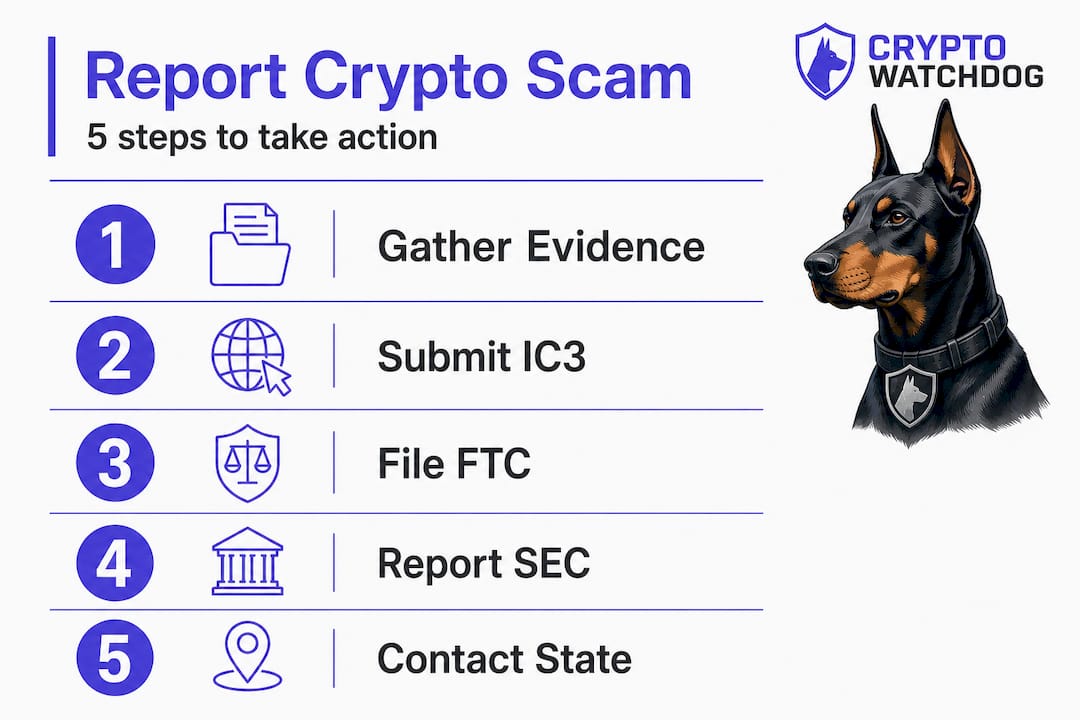
The standard reporting process involves submitting evidence to the IC3, SEC, CFTC, FTC, and applicable state regulators. Each authority has a different remit, and your scam type will determine which agencies are most relevant.
Step 1: File with the FBI's Internet Crime Complaint Center (IC3) Visit ic3.gov and submit a detailed complaint. Include all transaction hashes, wallet addresses, and communications. The IC3 aggregates reports nationally and shares intelligence with law enforcement at federal and international levels. This should be your first submission in nearly all crypto fraud cases.
Step 2: Report to the FTC (Federal Trade Commission) File at ReportFraud.ftc.gov. The FTC focuses on consumer fraud and uses aggregated data to identify patterns and issue public warnings. Individual case resolution is unlikely, but your report contributes to broader enforcement actions.
Step 3: Submit a tip to the SEC (Securities and Exchange Commission) If the scam involved tokens marketed as investments or promises of profit from others' efforts (which meets the legal definition of a security), report via the SEC's Tips, Complaints, and Referrals portal. The SEC has pursued enforcement against multiple fraudulent token issuers.
Step 4: File with the CFTC (Commodity Futures Trading Commission) The CFTC oversees commodity fraud, and Bitcoin and Ether are classified as commodities under US law. Scams involving these assets, or leveraged crypto trading fraud, fall within their jurisdiction. Use the SmartCheck portal at cftc.gov.
Step 5: Contact your state financial regulator Many states operate independent securities or financial fraud divisions. A quick search for your state's financial regulator will surface the relevant contact form. Some state-level agencies have moved faster than federal bodies on certain crypto fraud cases.
Step 6: Notify the exchange that processed your funds Contact the customer support team of any legitimate exchange you used to send funds. While they cannot reverse blockchain transactions, they can flag destination wallets and, in some cases, freeze associated accounts if the scammer is also a user of that platform.
| Authority | Jurisdiction | Best suited for |
|---|---|---|
| FBI IC3 | Federal criminal fraud | All crypto fraud types |
| FTC | Consumer protection | General investment fraud |
| SEC | Securities law | Token and investment scams |
| CFTC | Commodity regulation | Bitcoin, Ether, leverage fraud |
| State regulator | State law | Local or smaller-scale fraud |
Warning: After filing a report, you may be contacted by individuals claiming to be "crypto recovery specialists" who can retrieve your lost funds for an upfront fee. This is almost always a secondary scam. We strongly advise you to review our guidance on how to avoid fund recovery scams before engaging with any third-party recovery service.
What happens next: outcomes, tracking, and protection
After submitting your report, here is what you can realistically expect and how to stay secure going forward. Managing expectations at this stage is important, because misplaced hope can make you vulnerable to secondary fraud.
Reporting with detailed blockchain data can aid investigations and help law enforcement link multiple cases, but direct fund recovery is rare. Most crypto fraud originates from international criminal networks operating in jurisdictions with limited legal cooperation. Authorities typically use your data to build broader cases that may result in arrests or asset freezes over months or years, not days.
What typically happens after filing:
- You receive an automated confirmation reference number from each agency.
- IC3 and the FTC may share your data with relevant law enforcement partners.
- In rare cases, particularly where the scam is large-scale or well-documented, you may be contacted by an investigator for additional information.
- Exchange-level flags occasionally result in frozen wallets if the scammer is still active on that platform.
Professional scammer networks often target victims a second time with so-called "recovery agents" or by posing as government officials who claim they can unlock frozen funds for a fee. This is one of the most insidious aspects of modern crypto fraud: victimisation does not end with the initial scam. The danger of recovery scams is real and well-documented, and our recent recovery scams alert tracks active operations targeting previous victims.
Pro Tip: After reporting, monitor your wallet addresses using blockchain explorers. If the scammer's wallet receives further deposits from other victims, that additional on-chain data may be relevant to ongoing investigations and worth supplementing to your original report.
Going forward, consider hardening your operational security: use hardware wallets for significant holdings, revoke unused token approvals via tools like Revoke.cash, and treat any new investment introduction with the same critical scrutiny you now have. Prevention, as difficult as it sounds after a loss, is still your most effective protection.
Why speed and scepticism matter more than technology
Reflecting on the scam reporting process, and on the volume of cases we analyse here at Crypto Watchdog, one conclusion emerges clearly: most losses are not the result of inadequate technical tools. They result from delayed action or a lapse in sceptical judgement.
The crypto industry tends to frame security as a technical problem, and the solutions proposed are almost always technical: hardware wallets, multi-signature setups, blockchain analytics platforms. These tools are genuinely useful. But the majority of victims we see did not lose funds because they lacked a hardware wallet. They lost funds because they did not act on a feeling of doubt quickly enough, or because they extended trust in a situation that did not warrant it.
Preventing scams ultimately prioritises scepticism over greed, and that is a mindset shift, not a software update. Every investor should internalise the principle that promising returns without corresponding risk is not an opportunity. It is a manipulation attempt. That framing, held consistently, blocks the vast majority of social engineering attacks before they gain any traction.
Our contrarian view is this: waiting for absolute certainty before reporting is often riskier than reporting on suspicion. If you think something is wrong, file a report. You can always provide additional evidence later, and an early flag on a scammer's wallet may protect other investors even if your own funds are not recovered. The culture of reporting, even in cases where personal restitution is impossible, strengthens the overall ecosystem. It generates the aggregate data that enables enforcement agencies to identify criminal networks, issue public warnings, and occasionally make arrests that stop further harm.
If you are evaluating any new platform and want to protect your investments through informed decisions, the single most valuable habit you can develop is asking hard questions before you deposit, not after.
Stay proactive with independent scam alerts and education
Protecting yourself from crypto fraud is not a one-time task. The threat landscape shifts constantly as scammers refine their tactics, launch new fraudulent platforms, and target fresh investor cohorts with increasingly convincing operations.
Crypto Watchdog publishes ongoing latest scam warnings covering newly identified fraudulent platforms, recovery scam waves, and phishing campaigns targeting specific exchanges. Each alert is grounded in evidence gathered through our 8-point audit framework and live platform testing, so you are reading verified intelligence rather than speculation. For investors who want to go further, our in-depth safety education library covers everything from evaluating exchange legitimacy to understanding DeFi risk. Staying informed consistently is the most reliable edge you have against the next generation of crypto scams.
Frequently asked questions
How quickly should I report a suspected crypto scam?
Report within the first 24 to 48 hours wherever possible, as early reporting gives investigators the best chance of flagging wallets and tracing funds before they are dispersed further.
Which authorities handle crypto scam reports?
Scam reports can be filed with the FBI IC3, the FTC, the SEC, the CFTC, and your state's financial regulator, with the appropriate authority depending on the scam type and assets involved.
What evidence do I need to gather before reporting?
Collect transaction hashes, wallet addresses, all communications with scammers, dated screenshots, and the names of any platforms used; organising this evidence thoroughly significantly strengthens your submission.
Can I get my stolen crypto back after reporting?
Direct restitution is rare given the international nature of most crypto fraud operations, but reporting assists law enforcement in building cases that may prevent further losses for other investors.
How can I avoid recovery scams after being targeted?
Do not engage with unsolicited contacts claiming they can recover your funds; these are almost always secondary scams specifically designed to defraud victims a second time.
Recommended
Disclaimer
This content is for informational purposes only and does not constitute financial advice. Always do your own research.
Related guides
How to review crypto platforms safely and avoid scams
Unlock the secrets to safe trading with our comprehensive crypto platform review guide. Learn to spot scams and protect your investments!
SafetyHow to identify and avoid crypto scams: investor guide
Learn what is a crypto scam and how to identify and avoid them. Safeguard your investments with our essential guide on spotting scams today!
SafetyHow to verify crypto wallet safety and avoid scams
Learn how to verify crypto wallet safety and avoid scams with our step-by-step guide, ensuring your investments are well-protected.
SafetyUnderstand crypto deposit risks and protect your funds
Learn what are crypto deposit risks and how to protect your funds effectively. Safeguard your investments with practical insights!
SafetyCrypto Recovery Scams: Why "Fund Recovery" Services Are Almost Always a Second Theft
If you have lost crypto, the "recovery experts" messaging you are usually running a second scam. Here is how advance-fee recovery fraud works, the red flags to spot, and the only legitimate ways to report a theft, backed by the FBI, FTC, FCA and CFTC.
SafetyWhy Avoid Risky Crypto Services: Protect Your Investments
Discover why risky crypto services cost investors millions and how to protect your funds with evidence-based checks before trusting any platform.