Why crypto platform trust is key to your security

When Hedgey Finance was exploited for $44.7 million across Arbitrum and Ethereum in a single attack, it served as yet another stark reminder that no platform is immune to catastrophic failure. Crypto investors face a landscape where genuine threats evolve faster than most security teams can respond, and where brand recognition offers no meaningful protection whatsoever. This article maps out the core pillars of platform reliability and security, so you can move beyond assumptions and make genuinely informed decisions about where you place your funds.
Table of Contents
- What does trust mean in crypto platforms?
- How to identify a trustworthy platform: Red flags and essentials
- Independent audits, trust scores, and ongoing platform testing
- User actions: How to protect yourself and reinforce trust
- Why most users overestimate platform safety: The myth of 'too big to fail'
- Find trusted crypto platforms with Crypto Watchdog
- Frequently asked questions
Key Takeaways
| Point | Details |
|---|---|
| Pillars of trust | Security, transparency, regulation, and user protections are essential when vetting crypto platforms. |
| Spotting red flags | Warning signs like unclear fees, anonymous teams, or no audits should prompt extra caution. |
| Independent checks | Audits and trust scores empower investors but should be paired with personal security practices. |
| Personal responsibility | Active steps like verifying URLs and staying up to date with warnings protect you, even on trusted sites. |
What does trust mean in crypto platforms?
With a clear sense of the urgency around trust, let us break down what genuine trust in a crypto platform actually entails.
In traditional finance, trust is largely underwritten by government-backed deposit insurance, regulatory oversight, and decades of institutional accountability. In crypto, none of those safety nets are guaranteed. A platform can vanish overnight, freeze withdrawals without warning, or suffer a catastrophic breach that leaves users with no legal recourse. This is not a niche risk. It is the operating reality for anyone holding funds on a centralised exchange, a DeFi protocol, or even an audited wallet application.
Genuine trust in a crypto platform rests on four measurable pillars, each of which demands active verification rather than passive assumption:
| Pillar | What it means | How to verify it |
|---|---|---|
| Security | Robust technical defences against hacks and exploits | Smart contract audits, penetration test reports |
| Transparency | Open communication about fees, ownership, and operations | Published team details, public financials |
| Regulation | Registration with recognised financial authorities | Licence numbers, regulator databases |
| User protections | Withdrawal rights, dispute processes, insurance | Terms of service, proof-of-reserves reports |
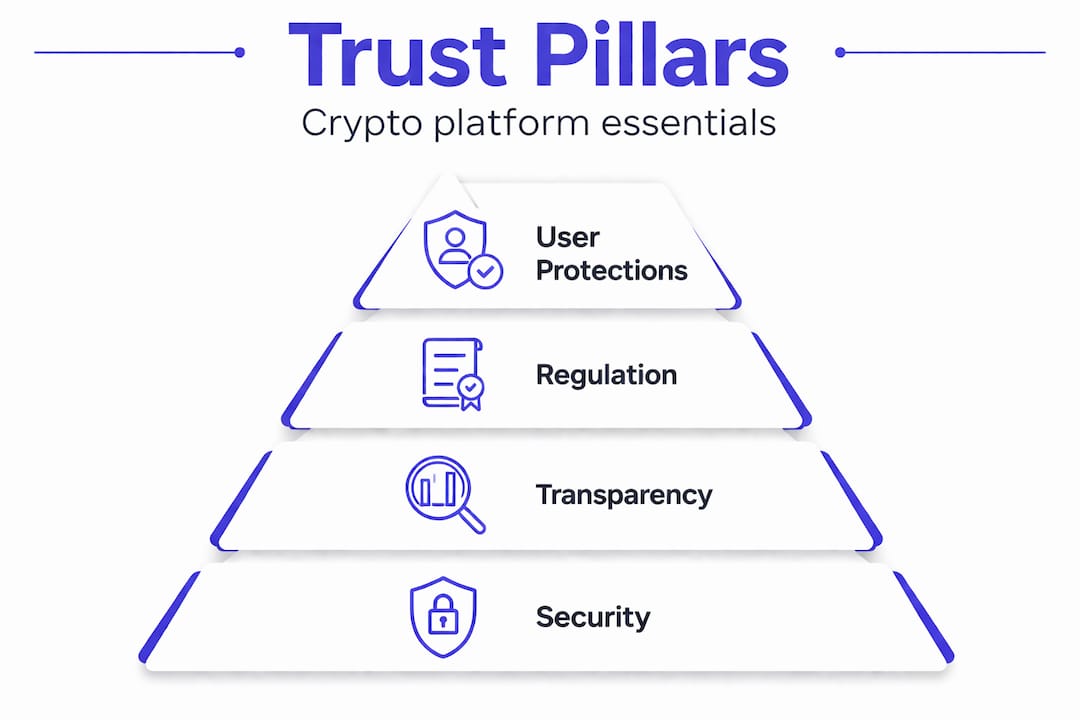
As we assess in our practical guide on choosing a safe crypto exchange, regulation, transparency, and user protections are not optional extras; they are the baseline every credible platform should meet without exception.
When you first land on a new platform, there are several immediate trust indicators worth scanning for:
- Proof-of-reserves reporting: Does the platform publicly verify that user funds are held in full?
- Identifiable leadership: Are founders and directors named, photographed, and verifiable through professional networks?
- Regulatory disclosures: Is a licence number or registration reference displayed clearly in the footer or legal pages?
- Audit publication dates: Are security audits recent (within the last 12 months), or are old reports being used to imply current safety?
If you are uncertain what key questions to ask before committing funds to any platform, starting with these four pillars will immediately narrow down whether further investigation is warranted or whether a platform should be dismissed outright.
How to identify a trustworthy platform: Red flags and essentials
Now that we know what trust means, how can you spot it, or its absence, when browsing a new platform?
The gap between a polished marketing website and a genuinely secure platform is often substantial. Platforms have become increasingly sophisticated at presenting professional appearances whilst concealing fundamental structural weaknesses. Recognising the difference requires a structured approach rather than gut instinct.
Essential trust signals to look for
- Independent third-party audits: A credible platform will have its smart contracts or backend systems independently audited by recognised security firms, with full reports published publicly, not merely summarised.
- Regulatory registration: Look for verifiable registration with bodies such as the FCA (UK), FinCEN (US), or equivalent authorities in the platform's operating jurisdiction.
- Transparent fee structures: Fees should be clearly published before you commit to a transaction, without hidden charges appearing at the withdrawal stage.
- Named, verifiable founders: Founder identities should be cross-referenceable via LinkedIn, professional databases, or public company registrations.
- Accessible customer support: A responsive, reachable support team (not just a chatbot) is a meaningfully stronger trust signal than many users realise.
- Independently published user reviews: Look for third-party review aggregators, not testimonials hosted exclusively on the platform's own site.
Red flags that demand immediate caution
Opaque operations and unverified ownership are among the most frequently observed characteristics of fraudulent platforms, as our analysis of risky crypto services consistently demonstrates. Beyond anonymity, watch carefully for:
- Guaranteed returns or fixed yield promises with no credible mechanism explained
- Pressure tactics urging rapid deposits before an offer expires
- Withdrawal fees that appear only after funds are deposited
- No clear physical address or jurisdictional disclosure
- Social media profiles with very recent creation dates despite claims of long operational history
- Audit badges that link to expired, unavailable, or clearly unrelated reports
Security incidents at exchanges frequently trace back to neglected basics: unaudited smart contracts, reused administrator credentials, and inadequate two-factor authentication (2FA) policies across internal systems. These are not sophisticated attack vectors. They are failures of fundamental operational discipline.
Pro Tip: Before depositing any funds, search the platform name alongside terms such as "withdrawal issues," "frozen funds," or "scam" on independent forums. Community intelligence often surfaces problems that have not yet appeared in formal warnings.
| Platform characteristic | Trustworthy signal | Warning signal |
|---|---|---|
| Audit status | Recent, published, named auditor | Old, vague, or self-reported |
| Team identity | Named, verified, LinkedIn-active | Anonymous or pseudonymous only |
| Regulatory status | Registered, licence verified | Claims regulation without proof |
| Withdrawal process | Fast, tested, transparent | Reports of delays or denials |
| Review presence | Third-party review sites | Only platform-hosted testimonials |
Independent audits, trust scores, and ongoing platform testing
Essential to this trust evaluation are independent assessments and transparent ratings. Let us look at how these systems actually protect users in practice.
An independent audit, in the context of crypto platforms, is a formal assessment conducted by a third party with no financial stake in the platform's success. The key word here is "independent." Many platforms commission security reviews from firms they select and pay, which creates an inherent conflict of interest. A truly robust audit will be conducted by a firm with a public track record, will disclose its methodology, and will make the full report available rather than offering only a summary or a badge.
What a rigorous audit typically covers:
- Smart contract code review: Line-by-line examination for vulnerabilities, reentrancy attacks, and logic errors
- Access control assessment: Who holds administrative keys and under what multi-signature arrangements
- Backend infrastructure review: Server security, API endpoint protections, and data storage practices
- Withdrawal mechanism testing: Verification that user funds can actually be withdrawn as claimed
- Incident response protocols: Whether a clear plan exists for containing and communicating breaches
Independent audits and compliance checks form the foundational layer of user trust, but they are most valuable when conducted on a rolling basis rather than as a one-time exercise at launch. A platform audited in 2023 but substantially updated since may carry vulnerabilities its published audit never assessed.
This is precisely where trust scores add meaningful value. Trust scores synthesise multiple factors including audit recency, regulatory status, team verification, user complaint history, and live withdrawal test results into a single, interpretable indicator. Rather than expecting every user to read a 60-page technical audit report, a well-constructed trust score translates complex data into an accessible signal.
At Crypto Watchdog, we calculate trust scores out of 100 using an 8-point audit framework. A score above 75 indicates cautiously positive credibility. Scores below 50 trigger an orange or red alert, signalling that users should proceed with significant caution or avoid the platform entirely. You can read more about how trust scores work and what each component measures in our methodology guide.
We also conduct independent crypto audits that include live deposit and withdrawal tests, giving readers data from actual transactions rather than theoretical assessments. This matters because a platform can pass a code review whilst still failing to process legitimate withdrawal requests in practice.
Pro Tip: When reviewing an audit report, check the date carefully and look for a "scope of review" section. If the scope excludes key platform components such as the withdrawal engine or user data handling, the audit offers less protection than its headline suggests.
User actions: How to protect yourself and reinforce trust
Platform-level trust is only half the story. What actions can you personally take to further protect your assets, even on platforms that carry credible trust scores?
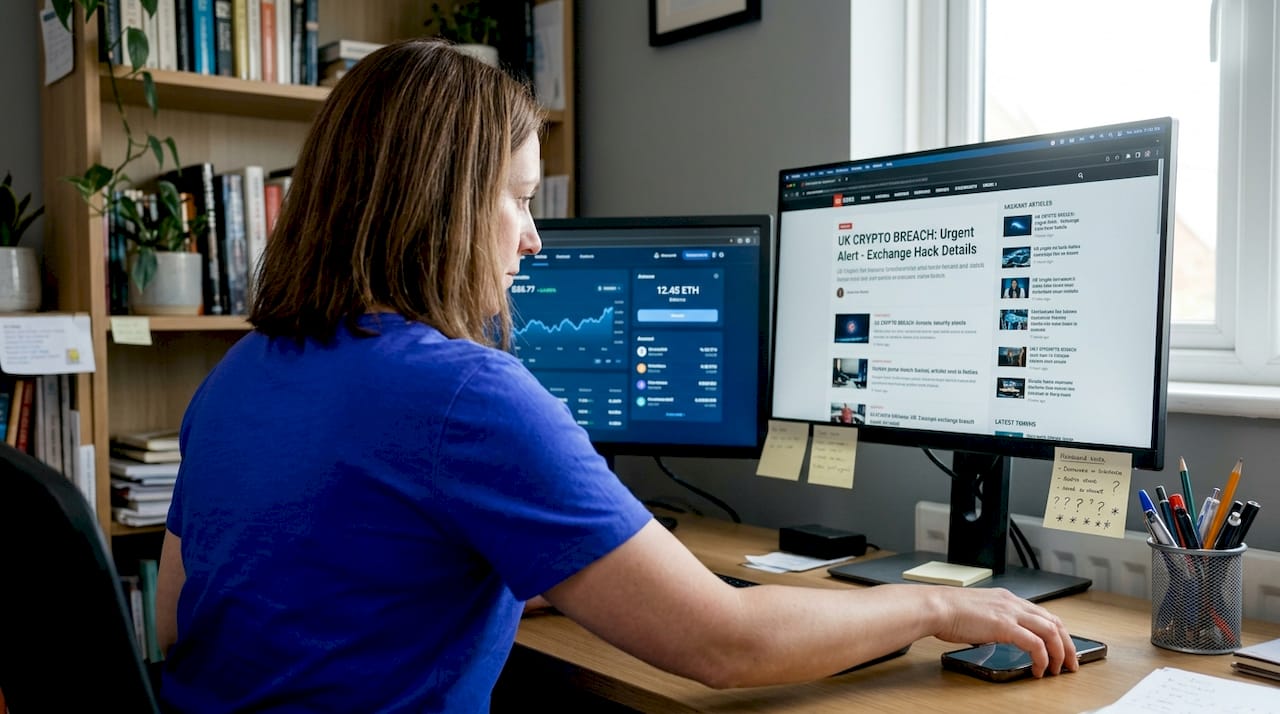
The critical point here is that platform trustworthiness and individual security hygiene are complementary, not interchangeable. Even a platform scoring 85 out of 100 on our audit framework cannot protect you if your account credentials are weak, if you are targeted by a phishing attack, or if you approve a fraudulent transaction without careful verification.
Here is a step-by-step framework for maintaining your own security posture as a crypto investor:
- Enable hardware-based 2FA: Use an authenticator app or a physical security key rather than SMS-based two-factor authentication, which is vulnerable to SIM-swapping attacks.
- Verify URLs manually before every login: Bookmark legitimate platform URLs and access them only from those bookmarks, never through search results or email links.
- Use a dedicated email address: Keep a separate email account exclusively for your crypto platform registrations, reducing the risk that a broader email compromise exposes your accounts.
- Check audit results independently: Do not rely solely on a platform's own claims about its safety record. Cross-reference audit reports through the auditing firm's own website.
- Stay alert to new warnings: Regularly review scam alert sections on independent monitoring sites to catch emerging threats before they affect your holdings.
- Limit exchange balances: Keep only the funds you actively need for trading on exchange accounts. Move larger holdings to self-custody wallets under your direct control.
"Even trusted platforms require users to maintain their own security and risk management protocols. Treating platform trust and personal vigilance as separate, parallel responsibilities is the most resilient approach available to individual investors."
Managing the risks associated with crypto bots and automated platforms demands the same active approach. Automated systems can execute transactions at speed, which means errors or vulnerabilities can compound quickly if users are not monitoring them closely and reviewing permission scopes regularly.
Why most users overestimate platform safety: The myth of 'too big to fail'
Let us shift perspective and confront a popular myth directly: that the biggest platforms are always the safest.
This assumption is one of the most dangerous held by crypto investors, and it has cost people substantial sums of money. The collapse of FTX, which was at the time one of the world's largest and most visible exchanges, did not emerge from obscurity. It emerged from a platform that had enormous brand recognition, celebrity endorsements, and a sophisticated public relations operation. None of that prevented the loss of billions in user funds.
Brand recognition is a marketing outcome, not a security outcome. These are entirely different things, and conflating them leaves investors exposed. What size and visibility actually signal is the capacity to invest in marketing, not necessarily the willingness to invest in security, compliance, or honest operations.
We have observed, in our ongoing platform assessments, that some of the most structurally sound crypto exchanges are smaller, more specialised operators who have prioritised compliance and audit transparency from launch precisely because they lacked the marketing budgets to build trust through brand alone. Their trust scores reflect rigorous operational discipline rather than polished advertising.
The practical implication for you as an investor is this: apply the same evaluation criteria to every platform regardless of its size or fame. Ask the same questions, look for the same verifiable evidence, and remain equally sceptical of vague reassurances whether they come from a startup or an industry giant. Ongoing vigilance and independent research are not activities reserved for evaluating new entrants. They are habits worth applying every time market conditions change, leadership teams shift, or platforms announce major structural updates.
Find trusted crypto platforms with Crypto Watchdog
Navigating the crypto landscape is substantially safer when you rely on evidence-based, independently conducted reviews rather than promotional claims from the platforms themselves.
At Crypto Watchdog, we publish detailed platform audits, trust scores, and colour-coded safety alerts to help you evaluate exchanges, wallets, trading bots, DeFi protocols, and crypto casinos before you commit any funds. Our team conducts live deposit and withdrawal tests, verifies team identities, and assesses regulatory status so you do not have to piece this information together yourself. You can also browse our recent scam warnings to check whether any platform you are considering has been flagged for suspicious behaviour, frozen withdrawals, or verified fraudulent activity. Making independent review a regular habit, not a one-time check, is among the most effective protections available to any crypto investor in 2026.
Frequently asked questions
What are the most important features of a trustworthy crypto platform?
Look for independent audits, regulatory registration, clear ownership, and real user reviews published on third-party sites rather than curated testimonials hosted by the platform itself.
Can independent audits fully guarantee a platform is safe?
No. Independent audits greatly improve transparency and identify known vulnerabilities, but users must also practise strong account security and stay alert to new threats that emerge after an audit's completion.
How can I check if a platform was involved in recent scams or hacks?
Review warning lists and incident reports on independent monitoring sites before depositing any funds, and search for platform-specific community feedback on forums and social media.
What steps should I take if I suspect my platform is unsafe?
Withdraw your funds immediately to a self-custody wallet, document all platform communications for potential reporting purposes, and flag the platform to an independent crypto risk monitoring service as quickly as possible.
Recommended
- Understanding Crypto Trust Scores: How We Rate Platforms | Crypto Watchdog
- 5 Questions to Ask Before Using Any New Crypto Platform | Crypto Watchdog
- Crypto Safety Reviews, Scam Alerts & Platform Audits | Crypto Watchdog
- Top crypto wallet features for safety and usability | Crypto Watchdog
- MT4/MT5 Trading Software Security: Protect Your Investments
Disclaimer
This content is for informational purposes only and does not constitute financial advice. Always do your own research.
Related guides
How crypto exchange trust frameworks help you trade safely
Discover how a crypto exchange trust framework enhances your trading safety. Learn the key criteria to choose reliable exchanges today!
ExchangesBenefits of self hosted crypto trading explained
Discover the benefits of self hosted crypto trading, from enhanced security to cost savings. Unlock your trading potential today!
ExchangesDemystifying crypto platform transparency for safer trading
Uncover the truth about crypto platform transparency explained. Learn how to secure your assets and trade safely in 2026's market.
ExchangesNavigating the Shifting Sands: Crypto Exchange Security in 2026
A calm, evidence-led look at crypto exchange security in 2026: what the Bybit hack and FCA enforcement teach us, how to read proof of reserves, and a practical checklist to protect your funds.
ExchangesTypes of crypto exchanges explained: how to choose
Confused by CEX, DEX, hybrid, and P2P exchanges? Learn how each type works, their real risks, and how to pick the right one for your trading goals.
ExchangesHow to Pick a Safe Crypto Exchange in 2026: A Practical Buyer's Checklist
A no-marketing guide to choosing a crypto exchange that won't freeze your withdrawals. Real solvency signals, the regulators that matter, fee traps to avoid, and how the major 2026 platforms compare on the things you actually care about.