Crypto performance audits explained: the investor's guide

Most investors treat a proof of reserves badge like a safety certificate. They see it, feel reassured, and move on. That assumption has cost people real money. Crypto performance audits explained properly reveal a far more demanding standard than a snapshot of assets, and understanding that distinction is essential before you trust any platform with your capital. This guide breaks down what genuine audit processes involve, where proof of reserves falls short, and how to read transparency reports critically so you can assess platforms with the same rigour auditors use.
Table of Contents
- What are crypto performance audits and why they matter
- The limitations of proof of reserves and what they really show
- How serious crypto audits manage scope, threat modelling and remediation
- Operational readiness and transparency controls behind trustable audits
- How to interpret and apply audit reports for safer investing
- Why most investors misunderstand audit reports and what actually matters
- Explore trusted crypto safety reviews and platform audits
- Frequently asked questions
Key Takeaways
| Point | Details |
|---|---|
| Proof of reserves limits | Proof of reserves only confirm assets at a snapshot and do not guarantee full solvency or liabilities disclosure. |
| Audit process essentials | Serious audits include scoping, threat modelling, manual review, severity rating, and remediation validation. |
| Operational controls impact | Segregated duties, multi-approval, and reconciliation build the trust foundation for credible audits. |
| Investor scrutiny needed | Reading audit scope, exclusions, and auditor credentials is critical to avoid false confidence. |
| Transparency vs safety | True platform safety depends on governance, controls, and stress resilience beyond mere data reports. |
What are crypto performance audits and why they matter
Crypto performance audits are not a single thing. The term covers a spectrum of reviews, from smart contract code analysis and security penetration testing to operational risk assessments and financial solvency checks. Each type answers a different question, and conflating them is where most investors go wrong.
At their most rigorous, crypto audit processes follow a structured risk management practice involving scoping, threat modelling, manual code review, remediation, and re-testing. This is not a checkbox exercise. It is a methodical investigation designed to surface vulnerabilities before attackers find them, and it requires significant time, qualified personnel, and documented methodology.
Why does this matter for you as an investor? Because the gap between a credible audit and a marketing badge is enormous, and platforms exploit that gap routinely. A platform might display an audit logo from a firm you have never heard of, for a review conducted on a version of code that no longer reflects the live system. Understanding crypto platform transparency means knowing exactly what questions to ask when you see that badge.
What a performance and security audit actually examines:
- Smart contract logic: Whether the code behaves as described, including edge cases and attack vectors like reentrancy and integer overflow
- Access controls: Who can authorise transactions, upgrade contracts, or pause operations, and whether those privileges are appropriately restricted
- Oracle dependencies: Whether price feeds or external data sources can be manipulated to exploit the protocol
- Operational risk: Whether the platform has the internal processes to maintain security after the audit is complete
- Incident response readiness: Whether the team has a documented plan to contain and recover from a breach
A crypto trading bot audit extends this further, examining algorithmic logic, API security, and execution integrity. The point is that performance evaluation in crypto is never one-dimensional, and investors who demand rigorous audit processes rather than polished pass badges are the ones best positioned to avoid serious losses.
The limitations of proof of reserves and what they really show
Proof of reserves (PoR) became prominent after the collapse of FTX in 2022. Exchanges rushed to publish reports showing they held assets equivalent to customer deposits. It looked like accountability. In practice, it was often far less than that.
A PoR report proves assets against customer balances at a single point in time, but it does not assure liabilities or verify whether those assets were borrowed temporarily to pass the snapshot. An exchange could borrow assets from a counterparty overnight, publish a clean PoR report, and return those assets the following morning. The report would show a fully backed exchange. The reality could be the opposite.
The critical problem: PoR is inherently limited and not equivalent to audited financial statements under PCAOB and SEC guidance. It omits liabilities, off-chain obligations, margin positions, legal claims, and pledged collateral, which means it cannot confirm solvency.
This is not a minor technical footnote. It is the central limitation that renders PoR meaningless as a standalone safety signal. Consider that a platform could hold 100% of customer deposits in crypto while simultaneously owing equivalent sums to institutional lenders through undisclosed credit facilities. The PoR passes. The platform is effectively insolvent. You would not know.
What a reliable PoR report should at minimum disclose:
- The exact snapshot date and time
- Which assets and wallets are included, and which are explicitly excluded
- Whether the auditor tested actual control of private keys or relied on self-attestation
- Methodology used to derive customer liability figures
- Any affiliated or counterparty assets that were excluded from customer balance calculations
- The auditor's credentials and the standards applied
When you review a safe crypto exchange checklist, PoR should appear as one data point among many, not as the primary indicator of trustworthiness. Treat a PoR report the way you would treat a photograph of someone's wallet. It shows what was there at one moment, not whether they also have debts they did not show you.
How serious crypto audits manage scope, threat modelling and remediation
Understanding how to audit cryptocurrencies at a serious level requires familiarity with the structured process that credible audit firms follow. It is not intuitive, and most published audit reports bury the methodology in ways that make it difficult for non-technical readers to assess quality. Here is what the process actually looks like.
Serious auditors begin with scoping and threat modelling before any code review begins, then move through remediation and re-testing before finalising their report. This sequence matters because each step informs the next.
The standard process for conducting crypto performance reviews:
- Scoping: The auditor and platform agree on exactly what code, systems, and time period fall within the audit. Anything outside scope is explicitly excluded. Vague or incomplete scoping is a red flag.
- Threat modelling: The auditor maps out privileged actors (admins, validators, oracle operators), their permissions, and the assumptions the system relies on. This reveals where the highest-risk attack surfaces are.
- Manual code review: Experienced auditors read the code line by line, looking for logic errors, access control failures, and vulnerabilities that automated tools miss. This is the most labour-intensive and valuable stage.
- Automated tooling: Static analysis tools like Slither or MythX scan for known vulnerability patterns. They are fast but generate false positives and miss novel attack vectors, so they supplement manual review rather than replace it.
- Severity classification: Findings are categorised as critical, high, medium, low, or informational. Critical findings can lead to total loss of funds. Informational findings are best-practice notes.
- Remediation and re-testing: The platform fixes identified issues. A credible auditor then re-tests those specific fixes to confirm they are effective and have not introduced new problems. This cycle may repeat.
- Final report with disclosed limitations: The published report should document all findings, their resolution status, and explicit statements about what the audit did not cover.
Pro Tip: When reading an audit report, go directly to the findings section and check the remediation status column. If critical or high findings are marked "acknowledged" rather than "resolved," the vulnerability still exists in the live system. A polished introduction does not offset unresolved critical issues.
When you use our step-by-step audit guide to evaluate platforms, cross-referencing this process with what a platform actually publishes will tell you quickly whether their audit is substantive or superficial. Platforms that share only a pass certificate without a detailed report are asking you to trust the conclusion without evidence, and that is not a request you should honour. For guidance on picking safe exchanges, audit quality is one of the most informative signals available.
Operational readiness and transparency controls behind trustable audits
A code audit is a point-in-time assessment. What happens on the platform between audits is equally important. This is where operational readiness and internal controls come in, and it is the dimension most investors overlook entirely.

Crypto treasury teams build internal controls, segregate duties, and reconcile on-chain transactions to create the audit trails that give subsequent reviews meaning. Without these ongoing practices, an audit conducted today tells you nothing reliable about how the platform will operate six months from now.
The operational controls that make audits trustworthy over time:
- Segregation of duties: No single person controls both the initiation and approval of significant transactions, reducing insider risk
- Multi-approval workflows: Large transfers or contract upgrades require sign-off from multiple independent keyholders
- Transaction logging: Every significant action is recorded with timestamps, authorisation details, and references to the corresponding policy
- Regular reconciliations: On-chain balances are reconciled against internal records on a defined schedule, catching discrepancies before they become crises
- Documented remediation history: Records of past findings and their resolutions demonstrate that the platform responds to audit findings rather than shelving them
Pro Tip: Ask any platform where their last audit finding reconciliation report is. Platforms with genuine audit readiness will have this documented. Platforms that deflect or respond with marketing language almost certainly do not have the internal controls to back their claims.
The following comparison illustrates what separates a platform that is genuinely audit-ready from one that merely publishes documents for optics.
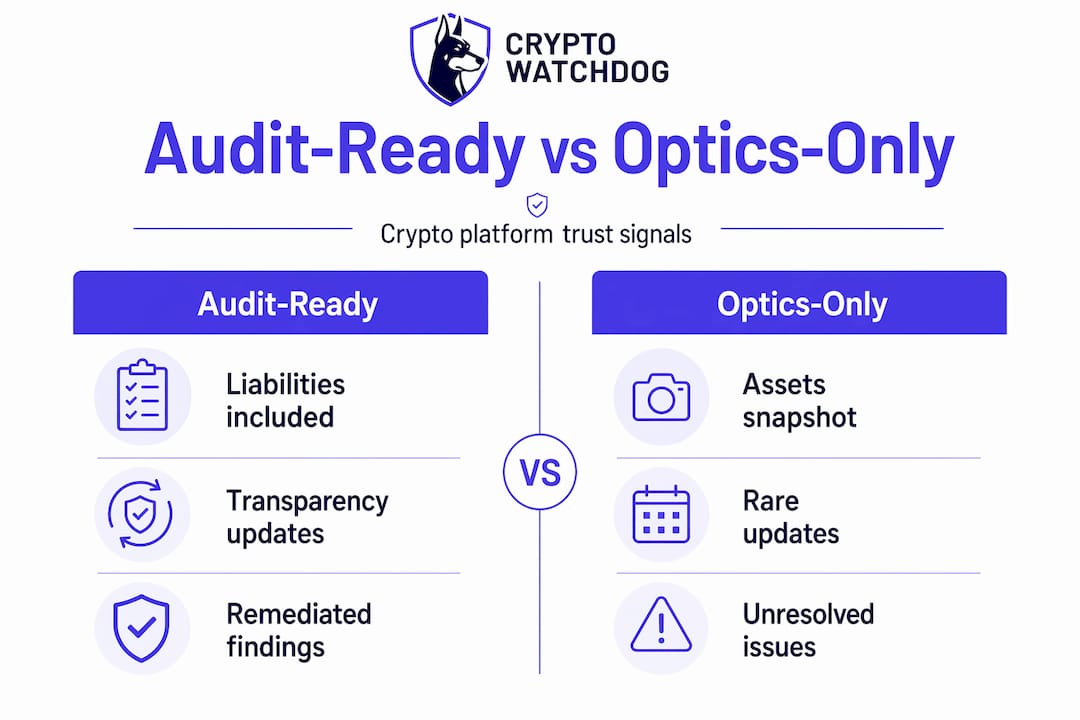
| Control area | Audit-ready platform | Optics-only platform |
|---|---|---|
| Scope of PoR | Includes liabilities, exclusions disclosed | Assets only, no liability disclosure |
| Code audit frequency | Annual minimum, after major updates | One-time or irregular |
| Remediation evidence | Re-test confirmation published | "Fixed" noted without verification |
| Internal reconciliation | Regular, documented, timestamped | Ad hoc or absent |
| Governance disclosures | Keyholders identified, policies published | Anonymous team, no governance documents |
| Incident response plan | Documented, tested, accessible | Unverified or undisclosed |
For a deeper look at what credible crypto transparency principles look like in practice, the distinction between these two columns is a reliable guide for making your own assessments.
How to interpret and apply audit reports for safer investing
Reading an audit report without a framework produces confusion rather than clarity. The best practices for crypto audits require you to approach these documents as an investigator rather than a passive reader. Here is the process we recommend.
Investors should examine report scope, exclusions, internal controls, and issuer credibility before placing trust in any audit or PoR report. That sounds straightforward, but the execution requires discipline.
Step-by-step process for applying audit information to your investment decisions:
- Confirm the audit scope first. What code, wallets, or systems were reviewed? What was explicitly excluded? Any gaps in scope are gaps in your knowledge about platform safety.
- Check the auditor's credentials. Is the firm well-known in the Web3 security space? Do they publish their methodology publicly? Have they audited protocols you recognise? Anonymous or unverifiable auditors are a serious risk indicator.
- Read the findings section. Do not skip to the summary. Look at every critical and high finding. Note whether each is marked resolved, partially resolved, or acknowledged only.
- Look for re-test confirmation. Were the fixes actually verified by the auditor, or did the platform self-report resolution? Only auditor-confirmed re-tests carry weight.
- Assess update frequency. An audit from 18 months ago on a protocol that has since undergone significant updates is largely irrelevant to current risk. Check whether the audit corresponds to the current live version.
- Look for governance and stress-testing disclosures. Does the report address who controls administrative keys? Does it mention formal risk frameworks or liquidity stress scenarios? Their absence is informative.
Additional indicators that suggest caution rather than confidence:
- Audit reports that cannot be downloaded directly from the auditing firm's own website
- Reports that contain no findings at all, which is statistically implausible for any real-world system
- Platforms that reference audits without linking to the full report
- PoR reports that omit methodology sections or are produced by newly established firms with no public track record
- Marketing materials that describe an audit as "passed" without distinguishing between severity levels of findings
Use the crypto exchange checklist to structure your broader due diligence. Audit findings are a critical input, but they work best alongside governance assessments, withdrawal testing, team verification, and regulatory status checks.
Why most investors misunderstand audit reports and what actually matters
We have reviewed a considerable number of crypto platforms, and the pattern we see most consistently is not outright deception. It is selective presentation combined with investor willingness to fill in the gaps optimistically.
A platform publishes a proof of reserves report with a credible-sounding auditing firm's name on the cover. Investors see the name, assume rigor, and never read the methodology section. That section, buried on page twelve, discloses that the auditor confirmed asset balances via management representation rather than independent on-chain verification. The entire report rests on the platform's own assertions. Most transparency documents lack the recurring internal reconciliations needed to make those assertions meaningful over time.
This is not a rare edge case. It is a common structural weakness in how crypto platforms approach transparency. And it reveals something important: the reliability of an audit is not determined primarily by the document itself. It is determined by the operational discipline that produces, supports, and sustains the data behind that document.
Investors who focus on report aesthetics, publishing frequency, and brand-name auditors often miss the more fundamental questions. Does this platform have documented internal controls that would make fraud difficult? Does it have a governance structure that prevents any single individual from moving large sums without oversight? Has it ever published an incident post-mortem that demonstrates accountability rather than silence?
Strong governance and a credible incident recovery plan are, in our assessment, more reliable signals of long-term trustworthiness than any single audit report. A well-formatted report from a recognisable firm tells you what was true on one day. Governance tells you how the platform will behave on all the days that follow.
Our guidance on avoiding risky crypto services addresses this operational dimension in detail, because it is the gap where financial losses tend to originate. Critical due diligence must account for liabilities, governance, stress resilience, and operational consistency, not simply for whether a platform received an audit certificate at some point in its history.
Explore trusted crypto safety reviews and platform audits
Knowing how to read an audit is valuable. Having access to independent analysis that has already done the hard work is even better.
At Crypto Watchdog, we conduct evidence-based platform reviews using an 8-point audit framework that covers security measures, withdrawal reliability, team transparency, and live deposit tests. Each platform receives a trust score out of 100 and a colour-coded risk alert, so you can assess safety at a glance while accessing the detailed methodology behind every rating. We also publish regular crypto scam alerts and warnings to keep you informed about fraudulent platforms, emerging tactics, and red flags our investigators have identified directly. Whether you are evaluating an exchange, a trading bot, or a DeFi protocol, our independent reviews give you a reliable starting point grounded in evidence rather than marketing claims.
Frequently asked questions
What is the difference between proof of reserves and a full audit?
Proof-of-reserves reports are inherently limited and not equivalent to audited financial statements, as they confirm assets at a single snapshot without verifying liabilities, governance, or solvency under regulatory standards.
Why should I be cautious about crypto platforms that only show proof of reserves?
Because PoR reports skip critical components like off-chain liabilities, margin obligations, and legal claims, meaning a platform can show a clean PoR while carrying hidden debts that would make it effectively insolvent.
What should I look for in a credible crypto performance audit?
Serious audit reports include scope, threat model, severity-classified findings, remediation details, and re-testing confirmation, so look for all of these elements plus clear disclosure of what the audit did not cover.
How do operational controls impact the reliability of crypto audits?
Strong internal controls and audit readiness are essential for trusted crypto audits because they create the transaction logs, reconciliation records, and approval trails that give auditors reliable data to review rather than unverifiable management assertions.
Are newer technologies like zero-knowledge proofs improving crypto audits?
Yes, zero-knowledge proof technology allows platforms to verify reserves without revealing individual user balances, which improves privacy-compatible transparency, though these tools address asset verification alone and do not resolve liability or governance risks.
Recommended
- Crypto trading bot audit: step-by-step guide for safe trading | Crypto Watchdog
- Before You Ape In: A Journalist's Guide to Vetting New Crypto Tokens | Crypto Watchdog
- How to review crypto wallets step by step for safer investing | Crypto Watchdog
- How to Pick a Safe Crypto Exchange in 2026: A Practical Buyer's Checklist | Crypto Watchdog
Disclaimer
This content is for informational purposes only and does not constitute financial advice. Always do your own research.
Related guides
Understanding crypto withdrawal risks: the investor's guide
Unlock the secrets of understanding crypto withdrawal risks. This guide equips you with essential insights to protect your investments and navigate...
WalletsCustodial wallets: Security, control and real risks explained
Explore the risks of understanding custodial wallets. Learn how they operate, protect your assets, and make informed crypto decisions.
DeFiTop DeFi platform risks every crypto investor must know
Uncover the crucial DeFi platform risks every crypto investor needs to know. Stay informed and protect your investments from costly mistakes!
WalletsUnderstand crypto wallets: Secure your digital assets
Discover what a crypto wallet is and learn how to secure your digital assets effectively. Make informed choices to protect your investments!
SafetyHow to identify and avoid crypto scams: investor guide
Learn what is a crypto scam and how to identify and avoid them. Safeguard your investments with our essential guide on spotting scams today!
SafetyHow to review crypto platforms safely and avoid scams
Unlock the secrets to safe trading with our comprehensive crypto platform review guide. Learn to spot scams and protect your investments!