Identify and manage crypto wallet risks for investor safety

Many traders believe that keeping their private keys secret is sufficient to keep their funds safe, but the reality is considerably more complex. Major losses in the crypto space regularly occur through malicious app installations, deceived transaction approvals, and misplaced trust in seemingly legitimate platforms, all without a single key ever being stolen. Whether you are a seasoned investor managing a diversified portfolio or someone relatively new to self-custody, the risk landscape for crypto wallets extends across multiple categories that deserve careful, systematic attention.
Table of Contents
- What defines crypto wallet risk?
- Remote compromise and user error: Main threats explained
- Wallet mechanics: Hot, cold, browser extension, and hardware
- Threat modelling: Wallet risks as a system
- Our view: Why conventional wallet advice still leaves gaps
- Where to get ongoing alerts and wallet reviews
- Frequently asked questions
Key Takeaways
| Point | Details |
|---|---|
| Risk is multi-dimensional | Wallet risks include remote attacks, approval mistakes, physical loss, and platform exposures. |
| Hot vs. cold wallet trade-offs | Hot wallets are more exposed online, while cold wallets risk loss or recovery error. |
| User behaviour is critical | Many losses occur from user-signing or approval mistakes, not just technical breaches. |
| Browser wallet vulnerabilities | Browser extension wallets are consistently affected by multiple attack vectors. |
| End-to-end system modelling | Risk mitigation works best when wallets are seen as part of an interconnected, threat-modelled system. |
What defines crypto wallet risk?
Most discussions of wallet safety centre almost exclusively on key management. Keep your seed phrase offline, never share your private key, and you will be fine. That framing, whilst not wrong, misses a substantial portion of the real threat surface facing investors today.
Wallet risk is most usefully understood by separating two distinct categories. First, there are remote compromise risks: malware, phishing campaigns, malicious or cloned wallet applications, and decentralised applications (dApps) that manipulate signing behaviour. Second, there are key-loss risks: seed phrase exposure, accidental deletion, operational mistakes during wallet setup or recovery. As Kaspersky's research on fake crypto wallet apps clearly illustrates, both categories operate independently, and a wallet can be drained even when the genuine keys are technically intact.
Hot wallets versus cold wallets represent the most fundamental structural distinction in risk profiling. Hot wallets, those permanently connected to the internet, expose your keys and signing processes to a wider attack surface. Cold wallets and hardware devices isolate the keys from network-accessible environments, substantially reducing the probability of remote theft. Ledger's security checklist summarises this clearly: wallet mechanics shape exposure in ways that no single behavioural change can fully compensate for.
Consider the following comparison to understand the risk profiles at a glance:
| Wallet type | Remote compromise risk | Key-loss risk | Physical risk |
|---|---|---|---|
| Hot (mobile/desktop) | High | Medium | Low |
| Browser extension | Very high | Medium | Low |
| Cold/paper wallet | Very low | High | Medium |
| Hardware wallet | Low | Low to medium | High |
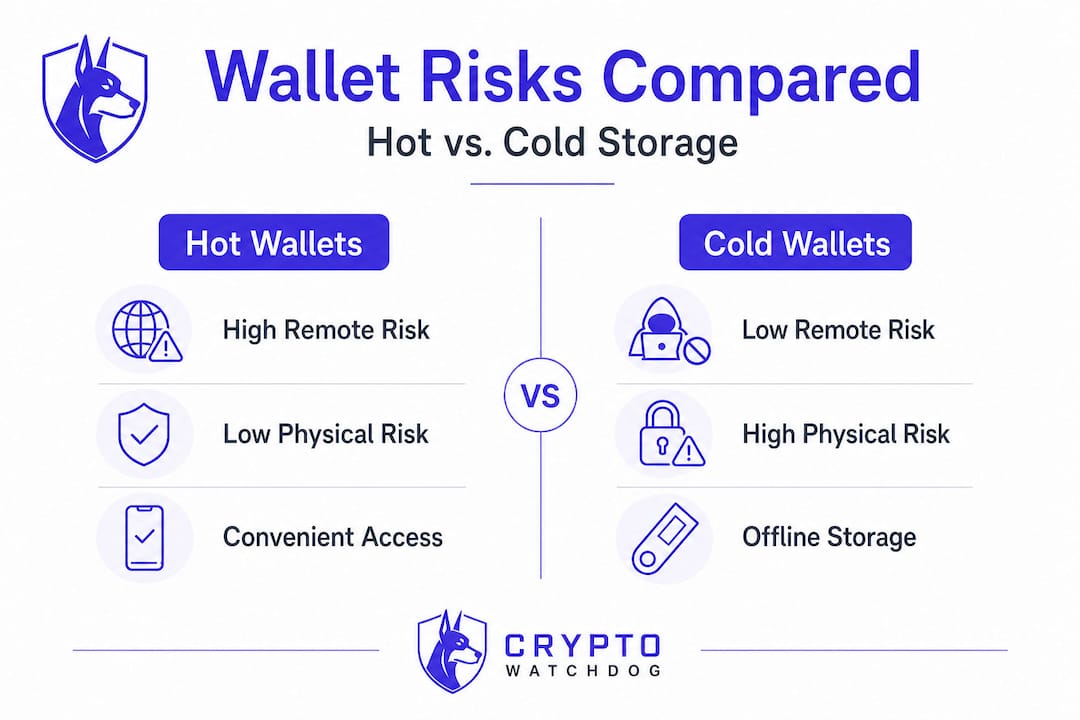
The statistical picture is equally important. Research consistently shows that wallet safety features vary considerably between products, and many investors choose wallets based on convenience rather than verified security architecture. Understanding which risk category is most relevant to your specific usage pattern is the necessary starting point for managing it effectively.
Key risk categories to keep in mind at this stage:
- Remote attacks targeting internet-connected signing processes
- Phishing and social engineering directed at seed phrase recovery
- Cloned or counterfeit wallet applications
- Operational errors during wallet creation or migration
- dApp permissions that grant excessive signing authority
Remote compromise and user error: Main threats explained
Remote compromise is the category of risk that most frequently catches investors off guard. Phishing attacks simulate legitimate wallet interfaces or support channels to extract seed phrases directly from users. Malware can silently record clipboard activity, capturing copied wallet addresses or seed phrases without any visible sign of intrusion. Malicious apps, often distributed through unofficial stores or social media promotions, mimic genuine wallets to redirect funds during setup.
One particularly dangerous vector is the hot vs cold wallet distinction as it applies to signing. Hot wallets execute transaction signing within an internet-connected environment, meaning that malicious code operating on the same device has a plausible pathway to intercept or manipulate the process.
However, hardware wallets are not immune from human error, and this is where many investors develop false confidence. The OWASP Web3 wallet security project makes the critical observation that even with secure hardware, users can still authorise malicious transactions by failing to scrutinise on-screen prompts carefully. A transaction that appears routine may contain hidden parameters granting an attacker unlimited token approval.
"Security architecture can reduce technical attack surfaces significantly, but human behaviour remains the most exploitable variable in any signing process. Defence-in-depth for crypto wallets must account for user error as a first-class threat, not an afterthought." — Aligned with OWASP Web3 security principles and NIST guidance on human factors in authentication.
To reduce your exposure to both remote compromise and user error, consider the following steps:
- Verify application sources before installation. Download only from official developer websites or verified app store listings with confirmed developer identities.
- Inspect transaction details on your hardware wallet screen, not on the connected computer, since the computer display can be spoofed by malware.
- Revoke unused approvals regularly. Tools exist specifically to audit and withdraw token spending permissions granted to dApps.
- Use a dedicated device for high-value wallet interactions, separating general browsing and social media from any signing activity.
- Treat every unsolicited support message as a potential phishing attempt, regardless of how professional it appears.
Pro Tip: Before connecting any wallet to a new dApp or DeFi protocol, use a wallet security analysis to verify whether that protocol has been audited and whether its permissions request aligns with its stated functionality.
Wallet mechanics: Hot, cold, browser extension, and hardware
Each wallet type carries a distinct risk profile shaped by its technical architecture. Understanding these differences helps you match the right tool to the right use case, rather than relying on a single wallet for all activity.
Hot wallets (mobile and desktop applications) store private keys in an internet-connected environment. They are convenient for active trading but expose users to OS-level malware, keyloggers, and screen capture utilities. The attack surface is broad because any compromise of the host device is effectively a compromise of the wallet.

Browser extension wallets represent a particularly high-risk category. Research published via WalletProbe on arXiv found that all browser-based wallet extensions tested were affected by at least three distinct attack vectors, with an average of 4.9 attack vectors per wallet. These vulnerabilities include UI redress attacks, malicious website interactions, and deceptive signing prompts. This is a materially higher exposure level than most investors realise when they install an extension wallet for convenient DeFi access.
Hardware wallets shift the risk profile meaningfully. By isolating key generation and transaction signing within a secure element chip, they eliminate most remote attack pathways. However, as Charles Schwab's wallet security guidance notes, cold and hardware wallets transfer risk rather than eliminate it. Physical loss, device damage, and failures during seed phrase recovery become the primary concerns. An investor who loses their hardware wallet and has inadequately stored their seed phrase may find recovery impossible.
Cold/paper wallets carry the lowest remote compromise risk but the highest operational and physical risk. A paper wallet damaged by water or fire, or one generated on a compromised computer, can result in permanent, unrecoverable loss.
| Wallet type | Best use case | Key risk to manage |
|---|---|---|
| Hot wallet | Small, active trading balances | Malware, phishing |
| Browser extension | DeFi interactions | Multiple attack vectors (avg. 4.9) |
| Hardware wallet | Medium to long-term holdings | Physical loss, recovery failure |
| Cold/paper wallet | Long-term cold storage | Physical damage, generation security |
Pro Tip: Review our hardware wallet guide before purchasing a device. Counterfeit hardware wallets are a documented threat, and verifying product authenticity before first use is essential.
Additional considerations specific to each wallet type:
- Browser extensions share memory space with the browser, creating pathways for cross-site scripting and malicious JavaScript
- Mobile wallet apps on rooted or jailbroken devices lose most of their native security guarantees
- Hardware wallet firmware updates require careful verification of authenticity before installation
- Multi-signature (multisig) setups distribute signing authority, reducing single-point-of-failure risks but increasing operational complexity
Threat modelling: Wallet risks as a system
The most effective approach to wallet security treats it not as a series of isolated decisions but as an end-to-end system. This perspective, supported by the ACM's security principles for wallet design, emphasises that vulnerabilities exist across keys, signing mechanisms, and external integrations simultaneously. Addressing only one layer while leaving others unexamined creates a false sense of security.
Threat modelling, a structured process for identifying assets, attack vectors, and mitigations, is the framework that security professionals use to evaluate this system view. For a wallet investor, a simplified threat model might look like this:
| Risk factor | Attack vector | Likely consequence | Mitigation |
|---|---|---|---|
| Phishing | Fake wallet site | Seed phrase theft | Bookmark official URLs |
| Malicious dApp approval | Excessive token permission | Fund drainage | Regular approval audits |
| Physical device loss | Hardware wallet stolen | Access risk if PIN weak | Strong PIN plus secure seed backup |
| Platform liquidity failure | DeFi protocol collapse | Inaccessible funds | Separate wallet-layer from platform risk |
| Malware on host device | Keylogger or clipboard capture | Key or phrase exposure | Dedicated signing device |
When DeFi protocol risks are introduced into the picture, the wallet's security perimeter expands well beyond the device itself. Connecting to unaudited protocols, granting broad permissions, or depositing funds into platforms with opaque liquidity structures introduces risks that no wallet architecture can protect against on its own. As the Bitcoin Policy Institute's research on crypto hacks and DeFi runs makes clear, DeFi wallet risk includes third-party and market risks that must be separated analytically from wallet-layer compromise.
This distinction matters practically. If a DeFi platform becomes insolvent or suffers a smart contract exploit, the funds are gone regardless of how secure your wallet application is. Understanding crypto deposit risk as distinct from wallet security risk helps investors assign responsibility correctly and avoid misplaced confidence.
Key systemic risk factors to monitor:
- Smart contract audit status of any protocol you interact with
- Governance token concentration (centralised control introduces manipulation risk)
- Liquidity depth of platforms holding your deposited assets
- Frequency of protocol upgrades or admin key activity
- Jurisdiction and regulatory status of custodial components
A review of the types of DeFi platforms available in 2026 reveals just how varied the risk profiles are across lending protocols, decentralised exchanges, and yield aggregators. Each category introduces distinct integration risks that extend your effective threat surface beyond what any single wallet security measure addresses.
Our view: Why conventional wallet advice still leaves gaps
Most wallet security guides focus predominantly on key management, and that is understandable given how frequently seed phrase theft drives losses. However, our review work across dozens of wallet products and associated platforms leads us to a firm position: key-centric advice alone is materially insufficient for the modern investor.
The investors we see suffer preventable losses most frequently are not careless with their seed phrases. They are people who signed a transaction they did not fully understand, connected to a protocol with excessively broad approval permissions, or downloaded a browser extension from a source that appeared legitimate but was counterfeit. None of those failures involved key theft in the traditional sense.
One mis-signed transaction can drain an entire wallet balance in seconds. One misconfigured dApp permission can allow a contract to withdraw funds on a timed basis, with no further user interaction required. These are not edge cases. They are documented, recurring patterns that conventional advice fails to address with sufficient urgency.
Our position is that investors should evaluate risk in context, not in isolation. A hardware wallet used to sign transactions on an unaudited DeFi protocol with broad approval permissions is not meaningfully safer than a hot wallet used cautiously with minimal integrations. The security of the signing device is only one variable in a multi-variable risk equation.
The practical implication is that security decisions should always account for the full interaction chain: device security, application authenticity, protocol audit status, permission scope, and physical backup integrity. Guidance on avoiding risky services is as relevant to wallet safety as any hardware or software recommendation.
Where to get ongoing alerts and wallet reviews
Crypto Watchdog exists precisely to help investors navigate the kind of multi-layered risk landscape this article describes. Our team conducts independent, evidence-based audits of wallets, exchanges, DeFi protocols, and associated services using a rigorous 8-point framework. Each review produces a verifiable trust score and a colour-coded alert, giving you a fast, reliable signal for any platform you are considering.
For wallet-specific hazards, our wallet scam alerts page maintains up-to-date warnings about cloned apps, malicious browser extensions, and fraudulent wallet support services. If a new threat emerges, we document it with evidence before publishing. Our crypto education resources section extends this further, offering structured guides on wallet mechanics, DeFi safety, and deposit risk management. Staying informed through a regularly updated, independent source is one of the most practical risk mitigation strategies available to any investor.
Frequently asked questions
What is a 'remote compromise' risk with crypto wallets?
Remote compromise risk refers to exposure from malware, phishing, and malicious wallet apps that access your wallet or manipulate the signing process, even if your private keys are never directly stolen.
Are hardware wallets completely secure from all types of risk?
Hardware wallets greatly reduce internet-based theft, but cold wallets shift risk towards physical loss, device damage, and recovery failures if the seed phrase is inadequately stored.
How can I avoid signing malicious approvals or transactions?
Carefully review every prompt on your hardware wallet's screen directly, limit dApp permissions to what is strictly necessary, and recognise that secure hardware screens reduce but cannot eliminate the risk of user signing errors.
What are browser extension wallet attack surfaces?
Browser extension wallets carry measurable technical vulnerabilities; WalletProbe research found all tested extensions were affected by at least three attack vectors, averaging 4.9 attack vectors per wallet, including UI deception and malicious site interactions.
Does DeFi activity affect my wallet risk?
Yes. DeFi platforms introduce third-party and market risks entirely separate from wallet-layer security, including liquidity failures and smart contract exploits that can drain funds regardless of how secure the wallet itself is.
Recommended
Disclaimer
This content is for informational purposes only and does not constitute financial advice. Always do your own research.
Related guides
Understand crypto wallets: Secure your digital assets
Discover what a crypto wallet is and learn how to secure your digital assets effectively. Make informed choices to protect your investments!
WalletsHow to review crypto wallets step by step for safer investing
Unlock safer investing with our step by step crypto wallet review. Learn to assess security, fees, and testing to protect your assets!
WalletsTop crypto wallet features for safety and usability
Discover the top crypto wallet features for maximum security and usability in 2026. Learn which hardware and software tools genuinely protect your digital assets.
WalletsHow to analyse crypto wallets for security and transparency
Learn how to analyze crypto wallets for security and transparency. Protect your assets and trade confidently with our essential guide!
WalletsCustodial wallets: Security, control and real risks explained
Explore the risks of understanding custodial wallets. Learn how they operate, protect your assets, and make informed crypto decisions.
SafetyHow to identify and avoid crypto scams: investor guide
Learn what is a crypto scam and how to identify and avoid them. Safeguard your investments with our essential guide on spotting scams today!