DeFi protocols: Security, transparency and risks explained

By Danny Allan
Founder & lead analyst, CryptoWatchdog · former Complaints Manager at Crypto.com
27 April 2026· Updated 18 June 2026

Decentralised finance is not just crypto speculation with a new haircut. At its core, a DeFi protocol is a set of smart contracts on a blockchain that delivers financial services — lending, borrowing, trading — without a bank or a broker sitting in the middle. The trouble is that most coverage either waves away how it works or treats security as a footnote. For anyone putting real money into this space in 2026, that gap costs people money. So this guide does the opposite. We will walk through how DeFi protocols actually work, where the security genuinely holds up, and where the weak points still catch out people who absolutely should know better. The thread running through all of it is DeFi protocol security — the part most guides skim and the part that decides whether you keep your funds.
Table of Contents
- Defining DeFi protocols: What makes them different?
- How DeFi protocols operate: The essential building blocks
- Types of DeFi protocols: Examples and real-world impact
- Risks and vulnerabilities: Security, transparency and attack vectors
- Lessons from DeFi in 2026: What most crypto guides miss
- Find trusted DeFi reviews and stay safe
- Frequently asked questions
Key Takeaways
| Point | Details |
|---|---|
| Smart contracts automate finance | DeFi protocols use blockchain code to provide financial services with no middlemen. |
| Transparency with new risks | Open, verifiable code improves visibility but introduces unique challenges like front-running and exploits. |
| Massive funds involved | DeFi systems hold hundreds of billions, so security and risk awareness are not optional. |
| Composable but vulnerable | Protocols connect together for innovation, but that also spreads risk from one to many. |
| Due diligence is essential | You need to research both the code and the ecosystem connections before trusting any DeFi protocol. |
Defining DeFi protocols: What makes them different?
So what actually separates a DeFi protocol from the bank you already use? It comes down to who, or what, is making the decisions.
At the most basic level, a DeFi protocol swaps the institutional plumbing of banking for code. In a traditional bank, a person approves a loan, a regulation governs it, and a private database records it. In a DeFi protocol, the same steps run on smart contracts that follow pre-set rules automatically. No loan officer. No compliance team. No internal ledger you are not allowed to see.
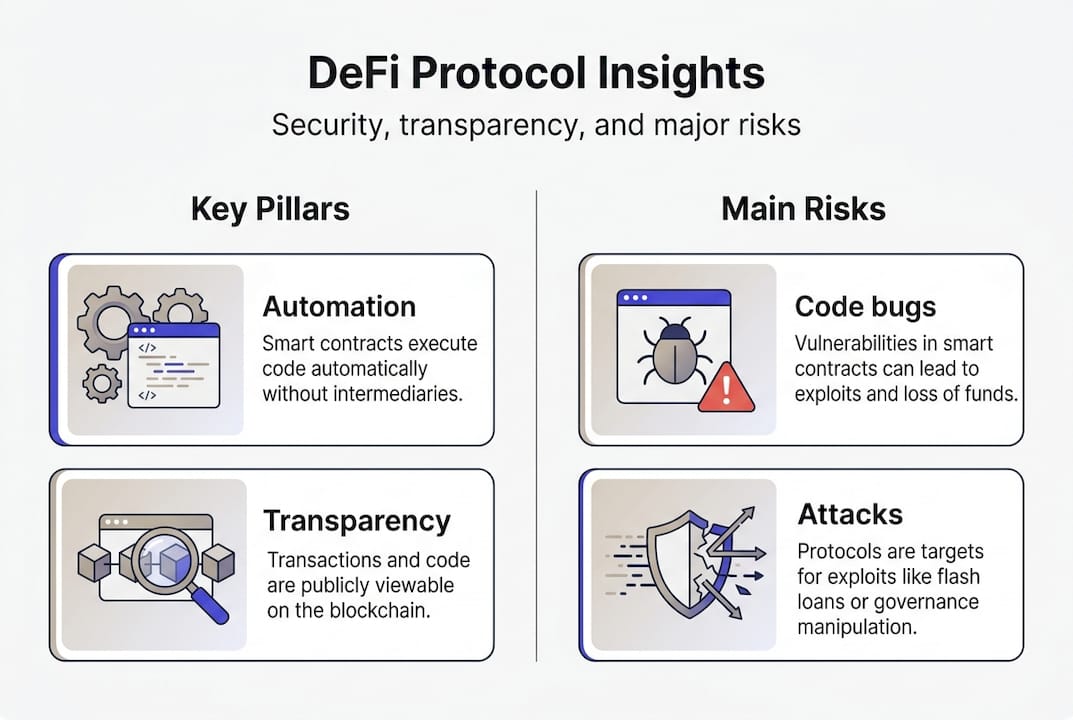
"All transactions and code are public on-chain, verifiable by anyone. This contrasts sharply with the opacity of traditional finance, but it also introduces novel risks such as front-running."
That openness is the thing DeFi fans point to most, and they have a point. Anyone can inspect a protocol's code on a block explorer, watch funds move in real time, and check that the rules are running exactly as written. Try doing that with your high-street bank. But here is the catch we will come back to: the same open code that lets you verify everything also lets an attacker study everything. The window swings both ways.
The main services a DeFi protocol enables fall into a few clear buckets:
- Lending and borrowing: Supply assets to earn interest, or borrow against collateral, with no credit check.
- Decentralised trading (DEX): Swap tokens straight from your wallet using automated market makers.
- Stablecoins: Tokens pegged to fiat currencies, backed either by collateral or by an algorithm.
- Yield generation: Earn returns by providing liquidity or staking assets in protocol-controlled pools.
- Real-world asset tokenisation: Bringing off-chain assets like bonds or property onto the blockchain.
You can see how the categories fit together in our guide to types of DeFi platforms, which walks through a safer way to approach each one.
| Feature | Traditional finance | DeFi protocols |
|---|---|---|
| Intermediary required | Yes (bank, broker) | No |
| Code transparency | Private | Fully public |
| Settlement speed | Days | Minutes to seconds |
| Access requirements | KYC, credit checks | Wallet and internet |
| Regulatory oversight | High | Limited or evolving |
Pro Tip: Before you touch any DeFi protocol, check the smart contract address against the official project documentation. Phishing sites routinely deploy copycat contracts with the same interface and malicious code hiding underneath. The front door looks identical; the lock is the attacker's.
The move from institution-driven to code-driven finance is a genuinely big deal. It removes single points of human failure, strips out a lot of middleman fees, and opens financial services to anyone with an internet connection. It also dumps the entire burden of due diligence on you. When a bank gets it wrong, a regulator can step in. When a smart contract does something you did not expect, there is usually no one to call and nothing to undo. That single fact shapes everything you need to understand about transparency in DeFi and trading bots alike.
How DeFi protocols operate: The essential building blocks
You have the definition. Now look under the bonnet, because the parts are where DeFi protocol security is won or lost.
The mechanics of DeFi protocols come down to a handful of components: smart contracts for automated execution, liquidity pools for shared funds, overcollateralised lending and borrowing, oracles for outside data, and composability that lets protocols plug into one another. Each does a specific job, and each fails in a specific way.
Here is how they fit together, in order:
- Smart contracts are self-executing programs deployed on a blockchain. When you deposit assets into a DeFi protocol, you are not trusting a company. You are trusting code. The contract runs exactly as written and cannot deviate — which is its strength right up until there is a bug in it, at which point it is also its biggest weakness.
- Liquidity pools are piles of tokens locked into a smart contract by users called liquidity providers (LPs). When you trade on a DEX like Uniswap, you are not matched with a counterparty. You swap against the pool. LPs earn a slice of the trading fees for supplying those funds.
- Overcollateralised lending is the model used by protocols like Aave and Compound. To borrow $100 of an asset, you have to put up $150 or more as collateral first. That cushion protects the protocol against price swings, but it also means DeFi lending is, for now, inefficient for borrowers compared with a normal loan.
- Oracles are services that feed outside data — usually price feeds — into smart contracts. Blockchains can't see off-chain data on their own, so protocols lean on oracles (such as Chainlink) to know what an asset is worth right now. Manipulate the oracle and every protocol depending on it is in trouble.
- Composability is the ability of DeFi protocols to call one another directly. One protocol can run a function inside another, so developers build complex products out of modular parts. People call it "money Legos." It is clever, and it stacks risk in layers we will dig into shortly.
| Building block | Function | Key risk |
|---|---|---|
| Smart contracts | Automate rules | Bugs, immutability |
| Liquidity pools | Enable trading | Impermanent loss |
| Overcollateralised lending | Borrow without credit checks | Cascading liquidations |
| Oracles | Provide external price data | Manipulation |
| Composability | Protocol interoperability | Systemic failure |
Pro Tip: Before you commit capital to any protocol, trace its DeFi protocol risks carefully, and pay close attention to which oracles it uses and which other protocols it leans on. One compromised dependency can drag your whole position down with it.
Types of DeFi protocols: Examples and real-world impact
With the foundations clear, let us look at the different types of DeFi protocols and the scale they have actually reached. These are not whiteboard ideas. They move real money, daily.
The DeFi ecosystem isn't one product. It is a stack of specialised protocols, each handling a distinct financial job. The headline examples: decentralised exchanges like Uniswap and Curve, lending platforms like Aave and Compound, stablecoins like DAI and USDC, liquid staking from Lido, and yield optimisers such as Yearn Finance.
Here is the lay of the land by protocol class:
- Decentralised exchanges (DEXs): Uniswap pioneered the automated market maker (AMM) model and made permissionless token swaps normal. Curve specialises in stablecoin trades with minimal slippage. Between them they now handle billions in daily volume.
- Lending protocols: Aave and Compound let you supply assets and earn interest, or borrow against collateral. Rates adjust automatically based on how much of the pool is being used, so the market is always rebalancing itself.
- Stablecoins: DAI is a decentralised stablecoin backed by crypto collateral and governed by MakerDAO. USDC is the centralised alternative, backed by cash reserves. Same job, very different risk profiles.
- Liquid staking: Lido lets you stake ETH while handing you a liquid token (stETH) that still works across DeFi. Your staked capital stops sitting idle, which is the whole appeal.
- Yield optimisers: Yearn Finance shuffles your funds between lending protocols to chase the best return, so you skip the manual yield-farming faff and just make one deposit.
The scale here is not small. DeFi's total value locked reached $237 billion in Q3 2025, with liquid staking protocols holding over $30 billion and real-world assets (RWAs) tokenised on-chain passing $12 billion by early 2026. Numbers like that put DeFi well past the experiment stage and into the category of genuine financial infrastructure.

| Protocol type | Key examples | Primary use case |
|---|---|---|
| Decentralised exchange | Uniswap, Curve | Token swapping |
| Lending and borrowing | Aave, Compound | Earn interest or borrow |
| Stablecoins | DAI, USDC | Price stability |
| Liquid staking | Lido | ETH staking with liquidity |
| Yield optimisers | Yearn Finance | Automated yield maximisation |
| RWA tokenisation | Ondo, Centrifuge | Real-world asset on-chain |
Before you chase any of these yields, read our analysis of DeFi lending real yield versus the inflated, unsustainable kind. Knowing which is which is the difference between earning interest and funding someone else's exit.
Risks and vulnerabilities: Security, transparency and attack vectors
This is the part most guides rush. Let us slow down on it, because DeFi protocol security is where the money is actually kept or lost, and the data is sobering.
DeFi protocols do offer real security advantages. Code-enforced rules remove human corruption at the execution layer. Every rule is public, testable and auditable. But those same traits open an attack surface that traditional finance never had to worry about. And the tooling is weaker than people assume: automated security tools detect access control vulnerabilities in only 3 to 8 percent of cases, which means the overwhelming majority of critical flaws slip straight past standard scanners. An audit badge tells you someone looked. It does not tell you they found everything.
"Composability is a double-edged sword: it enables innovative products but amplifies single-point failures across protocols, as evidenced by oracle manipulations and bridge exploits."
The real incidents make it concrete. Flash loans enable atomic multi-protocol attacks: an attacker borrows an enormous sum, manipulates a market or a governance vote, and repays the loan inside a single transaction block, all without putting up a penny of their own. The Kelp DAO bridge exploit led to $293 million in losses and contributed to Aave bad debt somewhere between $124 million and $230 million — a range, because the full figure is still being argued over, and we would rather give you the honest spread than a tidy false number. One vulnerability in one protocol, and the damage spread across the ecosystem.
The risk categories worth knowing cold:
- Smart contract bugs: Code flaws that let funds be drained, sometimes from protocols that passed several audits.
- Oracle manipulation: Pushing the price feed a protocol relies on, triggering false liquidations or handing the attacker cheap arbitrage at the protocol's expense.
- Bridge exploits: Bridges between blockchains have been among the most lucrative targets going, because they often hold assets in centralised custody.
- Flash loan attacks: Huge instant loans used to swing governance votes, drain pools, or set off liquidation cascades.
- Rug pulls and insider exploits: Project teams who quietly keep the admin keys and empty the protocol when it suits them.
We document the worst of it in our rug pull exploit risks warning and our coverage of pump-and-dump risks on Solana-based assets. Reading what actually happened to other people is the cheapest education in this space.
Here is a practical, numbered checklist every DeFi investor should run before depositing:
- Check the audit history. Confirm the protocol has been audited by at least two reputable firms, and read the reports yourself rather than trusting a one-line summary. A summary is marketing; the report is evidence.
- Assess the oracle dependency. Work out which price oracles it uses. A protocol leaning on a single, centralised oracle carries meaningfully higher manipulation risk.
- Examine composability depth. Count how many external protocols the platform depends on. Every extra layer multiplies your exposure to someone else's failure.
- Review admin key controls. Find out whether a multisig or a timelock guards the admin functions. A single unilateral admin key is a red flag, full stop.
- Monitor TVL trends. Sudden large outflows often mean someone knows about an exploit before the rest of us do.
Pro Tip: Use on-chain analytics tools to watch large wallet movements in and out of the protocols you hold. Unusual capital flight, especially from whale addresses, is frequently the earliest warning that an exploit is coming. By the time it hits the headlines, the smart money is already gone.
Lessons from DeFi in 2026: What most crypto guides miss
Most DeFi guides stop at the mechanics. They explain smart contracts, list the big protocols, quote the TVL figure, and sign off with a polite note about risk. What they keep underselling is the human and structural side of security in a system that calls itself trustless.
Decentralisation does not automatically mean safe. A protocol can be genuinely decentralised in how it executes while still parking enormous power with an anonymous developer team that holds the admin keys, controls the governance token supply, or can upgrade the contracts whenever it likes. We have reviewed plenty of platforms through our DeFi protocol risks work where the code was clean and the governance structure was the real hazard — and almost nobody was looking at it.
Composability is the feature guides love to celebrate and rarely interrogate. Developers admire how neat it is. For investors, it creates cascading risk that is genuinely hard to model. When a protocol you use plugs into five others, you are quietly trusting the security of all five, plus their oracle providers, plus the bridges joining them up. The Kelp DAO incident is the clearest lesson here precisely because no single component was obviously negligent. The failure came from the joins between them.
The most useful lesson we have drawn from years of evidence-based protocol assessment is blunt: treat the team and the governance structure as security factors, not marketing details. An anonymous team with an ungoverned upgrade path is a risk no matter how spotless the audit reads. Real transparency in DeFi is not just public code. It is verifiable accountability at every layer, including the people.
Find trusted DeFi reviews and stay safe
If you are weighing up DeFi protocols and want straight, evidence-based assessments instead of polished promotion, that is exactly what Crypto Watchdog is for.
We independently audit DeFi platforms, wallets, exchanges and crypto services against an 8-point framework covering security, team transparency, withdrawal reliability and real-world performance. Each review gives you a trust score and a colour-coded alert, so you can read the risk at a glance. Head to our crypto safety reviews for in-depth protocol assessments, or check the latest platform warnings for active scam alerts and exploit disclosures. We don't take payment for positive reviews, and every finding is evidence-based and independently verified. If we cannot stand it up, we don't print it.
Frequently asked questions
What is a DeFi protocol in simple terms?
A DeFi protocol is a group of smart contracts on a blockchain that delivers financial services — lending, borrowing, trading — without a bank or a central authority. The rules run in code rather than in an institution, which is the whole point and most of the risk.
Are DeFi protocols really transparent and secure?
A DeFi protocol's transactions and code are fully public on-chain and verifiable by anyone. That is real transparency. But the same openness introduces risks like front-running and exposes any logic flaw to attackers who are reading the same code you are. Transparent and secure are not the same thing.
What types of attacks are possible against DeFi protocols?
The common ones are flash loan exploits, oracle manipulation, rug pulls and bridge vulnerabilities. Large incidents like the Kelp DAO bridge exploit show how interconnected protocols can suffer cascading losses from a single point of failure.
How much value is locked in DeFi protocols in 2026?
DeFi's total value locked passed $237 billion in Q3 2025, with liquid staking protocols like Lido holding over $30 billion and real-world assets on-chain exceeding $12 billion by early 2026.
Can anyone create a DeFi protocol?
Technically, yes — anyone with the programming skills can launch one. Building a secure, trustworthy one is a different matter. That takes thorough independent audits, real governance controls, and a lot of real-world testing before public money ever goes near it.
Recommended
- Before You Ape In: A Deep Dive on DeFi Protocol Risks | Crypto Watchdog
- Understand all types of DeFi platforms for safer investing | Crypto Watchdog
- DeFi Lending in 2026: Real Yield vs Ponzi Yield (And How to Tell Them Apart) | Crypto Watchdog
- Telegram Trading Bots: Convenience at What Cost? | Crypto Watchdog
Related reading: Looking for a card that ships today? Read our Tangem Pay 2026 review — the most self-custodial Visa debit card actually live in 42 countries.
Disclaimer
This content is for informational purposes only and does not constitute financial advice. Always do your own research.
Related guides
Before You Ape In: A Deep Dive on DeFi Protocol Risks
A plain-English guide to the real risks behind DeFi yields in 2026 - smart contract bugs, oracle and flash-loan exploits, rug pulls and unsustainable APYs - plus a practical checklist to vet any protocol before you deposit a single penny.
DeFiTop DeFi platform risks every crypto investor must know
A plain-English walk through the DeFi platform risks that actually drain wallets: smart contract bugs, oracle and flash loan attacks, stablecoin depegs and governance capture, plus how to vet a protocol before you deposit.
DeFiDeFi's Dangerous Allure: What to Check Before You Deposit a Single Penny
DeFi can pay a real yield, and it can also empty your wallet in a single block. Here is a calm, evidence-led defi risks checklist for vetting a protocol before you deposit a penny.
DeFiUnderstand all types of DeFi platforms for safer investing
A calm, plain-English walk through the main types of DeFi platforms, with side-by-side risk and TVL data, real citations, and a framework you can use before you deposit a penny in 2026.
DeFiDeFi Lending in 2026: Real Yield vs Ponzi Yield (And How to Tell Them Apart)
A clear-eyed guide to where DeFi yields actually come from. We map the five legitimate sources of on-chain return, the patterns that quietly signal Ponzi mechanics, a practical due-diligence checklist, and the real collapses — Anchor, Celsius, BlockFi — that show what unsustainable yield looks like before it fails.
DeFiBefore You Click 'Approve': How to Vet a Smart Contract in 2026
Learning how to vet a smart contract takes minutes and free tools. Here's the calm, plain-English checklist we use — verified code, audits, token approvals and the habits that stop wallet drainers.