How to analyse crypto wallets for security and transparency

Imagine discovering that a wallet you've used for months has been flagged for indirect exposure to a sanctioned entity, not because of anything you did directly, but because of a transaction two hops removed in the chain. This scenario is far more common than most investors realise, and it illustrates precisely why wallet analysis is not optional for serious crypto participants. Understanding how to assess a wallet's security, transaction history, and risk profile is now a fundamental skill, one that protects your assets, your reputation, and your ability to trade on regulated platforms without disruption.
Table of Contents
- Preparing for wallet analysis: tools and requirements
- Step-by-step guide to analysing a crypto wallet
- Understanding and interpreting risk scores
- Troubleshooting and addressing common mistakes
- Verifying results and maintaining ongoing wallet safety
- What most wallet analysis guides miss: balancing automation and human expertise
- Go further with trusted crypto wallet analysis
- Frequently asked questions
Key Takeaways
| Point | Details |
|---|---|
| Risk scoring essentials | Understand how risk scoring measures exposure to illicit entities and why direct links carry high risk. |
| Step-by-step wallet review | Follow a systematic process using professional tools for accurate wallet risk analysis. |
| Human review matters | Always verify automated risk scores with expert review, especially when edge cases appear. |
| Ongoing safety routine | Establish quarterly audits and monitor wallet activity regularly to prevent security issues. |
| Trusted resources | Use reputable platforms for guidance, alerts, and education to stay ahead of wallet threats. |
Preparing for wallet analysis: tools and requirements
After understanding why analysis matters, let's get clear on what you'll need to begin the process.
Before you run a single query, you need the right toolkit. The quality of your analysis is only as good as the tools you use, and the crypto space has no shortage of unreliable or outright deceptive services posing as legitimate audit platforms.
Essential tools fall into three categories:
- Blockchain explorers (such as Etherscan for Ethereum or Blockchain.com for Bitcoin): these let you view raw transaction data, wallet balances, and counterparty addresses at no cost.
- Risk scoring platforms (such as Chainalysis, Elliptic, or open-source alternatives): these assess exposure to illicit entities including mixers, darknet markets, and sanctioned addresses, using hop distance and transaction volume to calculate a risk score.
- Wallet audit services: these go deeper, examining smart contract code, cryptographic implementations, and remediation evidence, particularly useful for DeFi wallets or custodial services.
You will also need the wallet address you intend to analyse, a basic understanding of how blockchain transactions are structured (inputs, outputs, UTXO models for Bitcoin or account-based models for Ethereum), and ideally a record of the transactions you expect to see.
Free vs. paid tools: a practical comparison
| Feature | Free tools | Paid/professional tools |
|---|---|---|
| Transaction history | Full | Full |
| Risk scoring | Limited or basic | Advanced, multi-hop analysis |
| Entity labelling | Partial | Extensive, regularly updated |
| Clustering analysis | Rarely available | Standard feature |
| Audit trail export | Manual | Automated reports |
| Customer support | Community-based | Dedicated analyst access |
Free tools are sufficient for basic due diligence, particularly for retail investors verifying incoming wallet addresses. For institutional-grade verification, or when a high-stakes transaction is involved, paid platforms provide meaningfully stronger attribution accuracy and more granular hop analysis.
Understanding wallet features for safety is also essential preparation, as security architecture influences how you interpret the data you retrieve. For a broader understanding of how wallet reviews are approached in practice, our crypto wallet review guide provides a structured starting point.
Pro Tip: Always verify the legitimacy of any analysis tool before entering a wallet address. Phishing tools designed to mimic legitimate platforms do exist, and submitting a wallet address to the wrong service can expose you to targeted attacks.
Step-by-step guide to analysing a crypto wallet
With your toolkit ready, here is how to complete a thorough wallet analysis that covers both security and transaction risk.
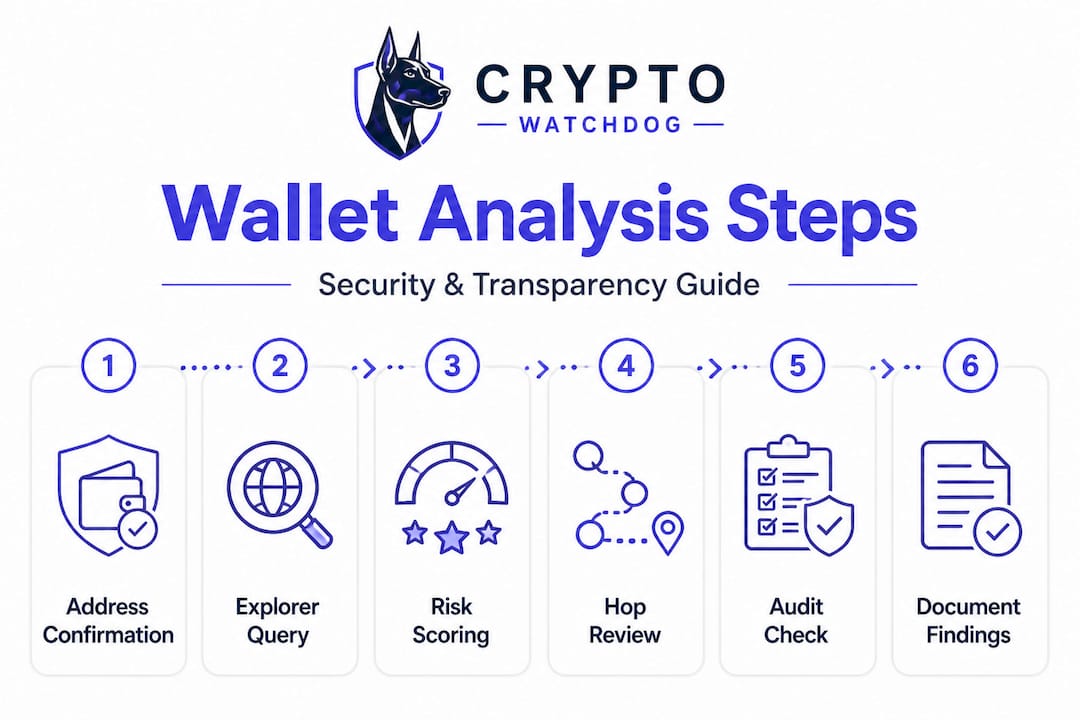
Step 1: Confirm the wallet address format. Before anything else, verify that the address is correctly formatted for its blockchain. A Bitcoin address and an Ethereum address look markedly different, and running an Ethereum address through a Bitcoin explorer will return no useful data.
Step 2: Run a blockchain explorer query. Paste the wallet address into your chosen explorer. Note the total transaction count, the age of the wallet (first and most recent transaction dates), the current balance, and the pattern of inflows and outflows. Unusually large single transactions, rapid balance movements, or dormant wallets that suddenly activate all warrant closer scrutiny.
Step 3: Execute a risk scoring check. Input the wallet address into your risk scoring platform. Wallet audits check code, audits, threat modelling, cryptographic primitives, and remediation evidence for security audits, while risk scoring specifically focuses on transaction graph analysis. The platform will calculate a risk score based on the wallet's exposure to flagged entities.
Step 4: Review the hop analysis. Pay particular attention to whether any flagged exposure is direct (1 hop, meaning the wallet transacted directly with an illicit entity) or indirect (2 or more hops removed). This distinction matters enormously for interpreting severity.
Step 5: Cross-reference with audit reports. If a formal security audit exists for the wallet software or custodian, retrieve it and check the audit date, the scope of testing, and whether identified vulnerabilities have been remediated.
Step 6: Document your findings. Export or manually record the key data points. A clear written record is essential if you need to escalate concerns to a compliance officer, legal team, or security analyst.
Understanding how trust scores are explained within a broader review framework can help you contextualise the numbers you receive. For questions about which wallet type to use in the first place, the comparison between hot wallets vs cold storage is worth reviewing before you finalise your storage strategy. You can also follow our step-by-step wallet review process to benchmark your approach.
Risk score reference table
| Score range | Risk level | Recommended action |
|---|---|---|
| 0 to 25 | Low | Proceed with standard monitoring |
| 26 to 50 | Medium | Investigate flagged counterparties |
| 51 to 75 | High | Pause transactions, consult analyst |
| 76 to 100 | Critical | Escalate immediately, do not transact |
Pro Tip: Treat clustering and risk scores as analytical inputs, not final decisions. A score of 72 does not automatically mean fraud; it means the wallet warrants further investigation by a qualified analyst before you proceed.
Understanding and interpreting risk scores
Once you have a score, understanding its true implications is crucial before taking any action.
Risk scores are probabilistic outputs, not definitive verdicts. The algorithms that generate them use clustering techniques to group addresses believed to belong to the same entity, based on patterns such as co-spending behaviour or shared inputs in Bitcoin transactions. These methods are powerful but imperfect.
Clustering is probabilistic; risk scores should be treated as analytical inputs rather than conclusions, and any high-risk finding should always be verified with qualified analysts before consequential decisions are made.
This is not a limitation to dismiss. It is a structural reality of on-chain analysis. When you receive a score indicating elevated risk, the appropriate response is investigation, not immediate action.
What to watch for when reviewing a risk score:
- Indirect links at 2 or more hops: a wallet may appear flagged simply because it received funds from an exchange that also served a flagged counterparty at an earlier point. The further the hop distance, the lower the practical risk.
- Unusually high transaction volumes through mixing services: this can inflate risk scores, but some users legitimately use privacy tools for entirely lawful reasons.
- Sudden score changes over time: if a wallet's score shifts significantly between reviews, investigate what new transactions or entity re-labellings occurred in the interval.
- Inconsistent entity labelling: different platforms may label the same entity differently based on their proprietary data. Cross-referencing two or more scoring services provides more reliable attribution.
- Sanctions exposure: direct or near-direct links to OFAC-sanctioned addresses are the most serious finding and require immediate professional review.
For further context on how interpreting trust scores works across different audit frameworks, our dedicated guide walks through the methodology in practical terms.
Troubleshooting and addressing common mistakes
After understanding scoring outputs, let us address the key issues and pitfalls you may encounter during wallet analysis.
One of the most consistent errors we observe is over-reliance on automated scores without accounting for the technical context of specific wallet types. False positives from CoinJoin, multi-signature wallets, and shared hot wallets are a known and documented issue that requires human review to resolve correctly.
Common mistakes in wallet analysis:
- Relying solely on automated scores without consulting the underlying transaction data or a qualified analyst.
- Ignoring the difference between direct and indirect exposure, which can lead to disproportionate responses to low-severity findings.
- Failing to account for privacy-enhancing tools such as CoinJoin, which combine transactions from multiple users and can create misleading clustering outputs.
- Treating multi-signature wallets as single entities: multi-sig wallets involve multiple signatories, and a flagged co-signer does not necessarily implicate all parties.
- Neglecting to update your analysis after major network events: hard forks, protocol upgrades, or exchange hacks can alter the risk profile of addresses that previously appeared clean.
- Skipping audit documentation review: a risk score tells you about transaction exposure, but it says nothing about whether the wallet software itself is secure.
Always conduct a human review of any unusual or high-risk findings before drawing conclusions. Automated tools are designed to flag, not to adjudicate.
If you are also assessing the broader trading environment around your wallets, understanding trading bot risk management is relevant, particularly for wallets connected to automated trading systems. Equally, familiarity with AI-washing red flags helps you evaluate the credibility of analysis platforms that claim artificial intelligence-driven scoring without substantiating those claims.
Verifying results and maintaining ongoing wallet safety
Now that common mistakes are addressable, ensure your system for verification and maintenance is robust enough to sustain long-term wallet safety.

Verification is the step most investors skip. They run a scan, receive a score, and move on. But a single audit is a snapshot, not a guarantee. Wallet risk profiles change as the broader network evolves, as counterparties transact, and as new entity labels are assigned by intelligence firms.
For investors, combining on-chain risk screening with wallet security audits provides the most thorough basis for transaction transparency and safety. Neither approach alone is sufficient.
Practical steps for ongoing wallet safety:
- Schedule regular audits: at minimum, conduct a full risk screening quarterly, and after any significant transaction involving a new counterparty.
- Monitor transaction history continuously: use alerts available in some blockchain explorer tools to notify you of new activity on watched addresses.
- Update your wallet software: outdated wallet firmware or application versions can introduce security vulnerabilities independent of on-chain risk.
- Maintain a verified address book: before transacting with a new address, run a preliminary risk check and verify the recipient through an out-of-band communication channel.
- Consult a security analyst for high-risk findings: do not attempt to interpret a critical-range score without professional guidance, particularly if regulatory compliance is a consideration.
- Review your wallet audit process periodically to ensure you are using current methodologies and up-to-date platforms.
Pro Tip: Build a routine for reviewing all wallet activity, not just major transactions. Small, recurring transfers to unknown addresses are a common early indicator of address poisoning attacks or compromised wallet keys.
What most wallet analysis guides miss: balancing automation and human expertise
Having worked through the technical steps, here is a perspective on the real-world challenges in wallet analysis that most guides overlook entirely.
The analytical community tends to present risk scoring as a straightforward, objective output. Feed in an address, receive a number, act accordingly. But attribution accuracy varies by time and role, and conservative labelling is consistently preferred by law enforcement precisely because the consequences of misattribution are serious.
What this means in practice is that the same wallet address can carry a different risk score today versus six months from now, depending on what new intelligence has been incorporated into the scoring platform's entity database. A wallet that appears clean today may be retroactively associated with a flagged cluster as more on-chain data becomes available.
Even the best clustering methods are not perfect. Conservative labelling is not a limitation; it is the responsible standard.
This has a direct implication for how you use wallet analysis: it should inform your ongoing risk management framework, not provide a one-time clearance. Treating a clean score as a permanent green light is one of the most dangerous assumptions an investor can make.
We also see a persistent gap between technical sophistication and practical judgement. Analysts who are highly skilled at running clustering queries sometimes lack the contextual knowledge to recognise when a flagged result reflects a privacy wallet, a liquidity pool interaction, or a legitimate high-volume trading operation rather than illicit activity. This is not a criticism of the tools; it is a reminder that they are instruments, not experts.
Building relationships with trusted, independent analysts, particularly for complex cases involving multi-sig wallets, DeFi protocols, or cross-chain transactions, is one of the most underrated investments you can make in your security posture. For cold storage decisions that intersect with these risks, reviewing cold storage tips is a sensible complement to your analytical process.
Pro Tip: Build relationships with two or three trusted analysts before you need them urgently. Emergency consultations under pressure lead to rushed decisions; established working relationships produce better outcomes.
Go further with trusted crypto wallet analysis
If the steps outlined in this guide have clarified how wallet analysis works, the next logical step is accessing consistently reliable resources that keep pace with an evolving threat landscape.
At Crypto Watchdog, we apply an independent, evidence-based 8-point audit framework to exchanges, wallets, trading bots, and DeFi protocols, assigning verifiable trust scores out of 100 so you can make informed decisions grounded in data rather than marketing claims. Our wallet scam warnings are updated regularly as new threats emerge, and our crypto wallet education section provides structured learning for investors at every stage of their analytical journey. Whether you are verifying a new wallet or reassessing one you have held for years, our resources are built to support exactly this kind of disciplined, ongoing scrutiny.
Frequently asked questions
What is risk scoring in crypto wallet analysis?
Risk scoring measures a wallet's exposure to illicit entities by analysing transaction paths and volume, with direct (1 hop) connections to flagged entities representing the highest risk level.
How do I interpret a high risk score?
A high risk score indicates direct or near-direct exposure to flagged entities and should always be verified with a qualified human analyst, because clustering is probabilistic and automated scores are not final conclusions.
What are common mistakes in wallet analysis?
Relying solely on automated scores or ignoring privacy-enhancing features such as CoinJoin can produce false positives in multi-sig and shared wallet scenarios, making human review an essential part of the process.
How often should I audit my crypto wallet?
At minimum, conduct a full audit quarterly, and by combining on-chain risk screening with security audits after any significant transaction involving a new counterparty.
Recommended
- How to review crypto wallets step by step for safer investing | Crypto Watchdog
- Top crypto wallet features for safety and usability | Crypto Watchdog
- Demystifying crypto platform transparency for safer trading | Crypto Watchdog
- 5 Questions to Ask Before Using Any New Crypto Platform | Crypto Watchdog
- Crypto compliance checklist for high-risk banking 2026
Related reading: Need to file your crypto taxes? Read our CoinLedger 2026 review — the #1 crypto tax software with TurboTax integration and 1,000+ supported wallets and exchanges.
Disclaimer
This content is for informational purposes only and does not constitute financial advice. Always do your own research.
Related guides
How to review crypto wallets step by step for safer investing
Unlock safer investing with our step by step crypto wallet review. Learn to assess security, fees, and testing to protect your assets!
WalletsCustodial wallets: Security, control and real risks explained
Explore the risks of understanding custodial wallets. Learn how they operate, protect your assets, and make informed crypto decisions.
WalletsUnderstand crypto wallets: Secure your digital assets
Discover what a crypto wallet is and learn how to secure your digital assets effectively. Make informed choices to protect your investments!
WalletsTop crypto wallet features for safety and usability
Discover the top crypto wallet features for maximum security and usability in 2026. Learn which hardware and software tools genuinely protect your digital assets.
WalletsHardware Wallets in 2026: The Honest Buyer's Guide (Tested Devices, Real Risks, Real Numbers)
A no-nonsense guide to choosing a hardware wallet in 2026 — what they actually protect you from, the real numbers behind crypto theft, and how the leading devices compare on security, supported coins, and price.
WalletsIdentify and manage crypto wallet risks for investor safety
Learn about defining crypto wallet risks and how to effectively manage them. Safeguard your investments with strategies for a secure crypto experience.