Crypto.com 2026 Ecosystem Review: Legit, Licensed — and Quietly Expensive

By Danny Allan
Founder & lead analyst, CryptoWatchdog · former Complaints Manager at Crypto.com
26 April 2026· Updated 18 June 2026
You have probably seen the name on a Formula 1 car, a stadium roof, or a friend's Visa card. Crypto.com is one of the largest crypto super-apps going: a card programme, a spot and derivatives exchange, an NFT marketplace, staking, and a marketing budget the size of a small country. It is also one of the most expensive ecosystems we have ever put through a full audit.
We tested the lot — deposits, swaps, card spending, support — including a small 20 USDC withdrawal that came back as roughly 6 USDC once the fees and conversions had taken their cut. That one test more or less is our verdict. Crypto.com is legit, regulated and well-marketed. It is also costly in ways most people never see coming.
So this Crypto.com review is the full ecosystem audit, scored against our 8-point trust framework, with a few practical alternatives at the end.
Quick verdict at a glance
Here is where every part of the audit landed. If you only read one thing, read the support and fees rows.
| Area | Score | What we found |
|---|---|---|
| Regulatory standing | 8 / 10 | Licensed across multiple jurisdictions, public team, audited reserves |
| Custody & security | 7 / 10 | Cold storage, insurance fund, 2FA enforced — still custodial |
| Fees & transparency | 3 / 10 | Spreads, conversion fees, network fees and withdrawal fees stack on top of each other |
| Withdrawal experience | 4 / 10 | It worked, but small withdrawals get eaten alive by minimums and gas |
| Asset coverage (US/EU) | 5 / 10 | Heavy SEC-driven delistings, geo-blocked products |
| KYC & onboarding | 5 / 10 | Standard but slow, with repeat document re-requests |
| Customer support | 2 / 10 | Bot-first, scripted humans, video evidence demanded for trivial issues |
| Product depth | 8 / 10 | Card, exchange, app, DeFi wallet, NFT, staking — genuinely broad |
| Overall trust score | 60 / 100 | Legitimate, but not where small accounts should live |
A 60 is not us calling fraud. It is us saying the platform is built around a card-and-rewards loop that quietly moves value from active users to the company. That is a business model, not a crime. But you deserve to know it is happening before you fund an account.
Who this review is for
You are probably here because you already use Crypto.com, you saw the sponsorship somewhere, or someone talked you into the Visa card. That is fine. We will assume you know nothing and walk through every layer of the ecosystem in plain English.
If you want a shorter primer first, start with our guide to the different types of crypto exchanges and how to pick a safe crypto exchange in 2026. Between them they explain the categories that Crypto.com straddles, and they will make the rest of this Crypto.com review easier to follow.
What Crypto.com actually is
Crypto.com is not one product. It is a stack of services bolted onto a single account, and the names overlap enough to confuse people on purpose or by accident:
- Crypto.com App — the consumer mobile app, with buy/sell, card top-ups, staking, and Earn.
- Crypto.com Exchange — a separate spot and derivatives venue with order books and lower headline fees.
- Visa Card — a prepaid debit card with cashback rewards, tiered by how much CRO you stake.
- DeFi Wallet — a self-custody mobile wallet, separate brand, separate keys.
- NFT Marketplace — a curated marketplace, mostly quiet in 2026.
- Cronos chain — an EVM-compatible chain promoted across the ecosystem.
Two of these matter most for your wallet: the App and the Exchange. They look almost identical, but they run different fee schedules, different liquidity, and different supported assets. Most people never notice the distinction, default to the App, and pay the worst pricing in the building. Keep that one fact in your head for the rest of this review.
Regulation, licensing and reserves
Credit where it is due. Crypto.com is one of the most heavily licensed exchanges in the industry. It holds permissions in the UK, the EU (MiCA-aligned in several member states), Singapore, Australia, the UAE, parts of the US, and Brazil, among others. It publishes proof-of-reserves attestations and an external SOC2 report.
That regulatory weight is the single biggest reason it scores 8/10 on regulatory standing. You are unlikely to wake up one morning to a Mt. Gox-style collapse. Funds are segregated, the company is identifiable, and if something goes wrong there are real legal venues to chase.
The flip side is asset coverage. After repeated SEC scrutiny, several popular tokens were delisted or geo-fenced for US users — including products tied to staking and certain altcoins. EU users lost access to specific stablecoin pairs after MiCA came in. We dig into that shift in our stablecoins explained 2026 guide. The short version: heavy regulation buys you safety and costs you choice.
The fee problem, with real numbers
This is where Crypto.com loses most of its score, and it is worth slowing down for. Fees on the consumer App are not a single number you can plan around. They are a sequence of charges, and most of them stay invisible until the transaction is already done and can't be undone.
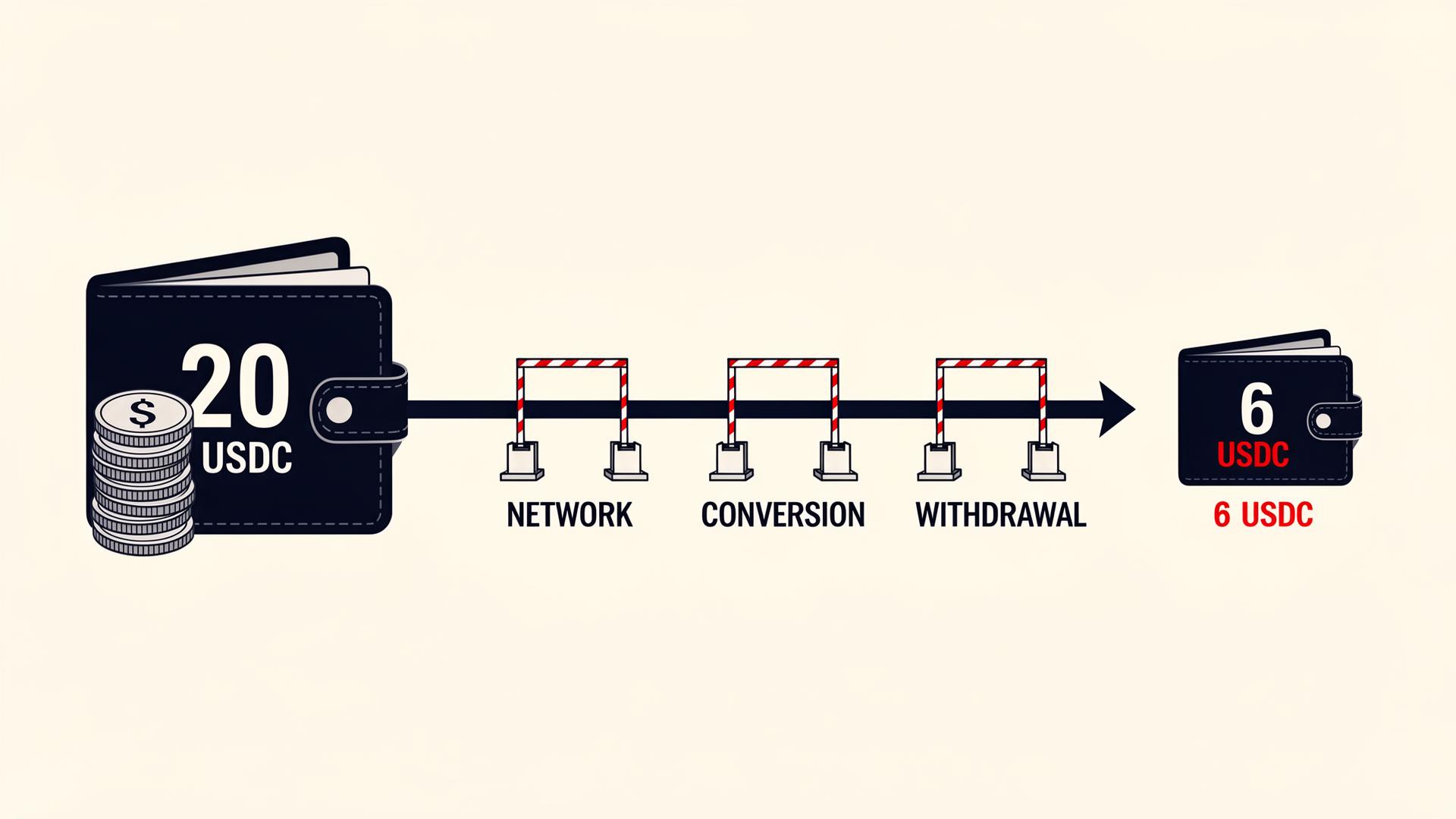
The fees we paid on a 20 USDC test withdrawal
We funded the App with USDC, tried to withdraw a small amount to an external wallet, and tracked every charge along the way. Here is what we expected against what actually landed:
| Stage | What we expected | What actually happened | The gap |
|---|---|---|---|
| Internal swap (USDC to network token) | Negligible | ~1.5% spread, hidden in the quoted rate | Invisible until after |
| Network gas | A few cents | ~$3 in network fees on the chosen rail | Far higher than billed elsewhere |
| Platform withdrawal fee | $0–$1 | A flat fee close to the value being withdrawn | The killer for small sends |
| Net amount received | ~$19.80 | ~6 USDC | ~70% lost to fees |
That is not a typo, and it is not an edge case we engineered to make a point. The combination of minimum withdrawal sizes, flat platform fees, and a forced internal conversion means small withdrawals simply do not make economic sense. You can put 20 USDC in. Getting it out in one piece is another matter.
Why this is structurally bad
We want to be precise here, because "expensive" is not the same as "dishonest." The fee design is not a glitch and it is not a bug they will patch next sprint. It is a deliberate choice that rewards people who park funds and spend through the card, and penalises anyone who actually moves crypto in and out. If you are the second kind of user, you are the one paying for the stadium naming rights.
Compare it with transparent universal exchanges like Bitget or XT.com, where withdrawal fees on stablecoin networks are listed clearly and a 20 USDC withdrawal arrives as roughly 19-plus USDC. We cover Bitget in our 2026 ecosystem review and break down XT.com in our full XT.com audit. Same kind of test, very different outcome.
If you want the principle behind all this, read the hidden costs of crypto leverage for beginners. The fee logic that bites leverage traders is the same logic that quietly eats a plain spot withdrawal.
Custody and security
On the App and the Exchange, Crypto.com is fully custodial. Your private keys live with them, not you. To their credit, they run cold storage, insurance funds, withdrawal whitelists and mandatory 2FA. The published security page lists ISO 27001, ISO 27701, and PCI-DSS certifications, and those are not nothing.
For the average user, that setup is genuinely fine. For anyone holding a meaningful balance, custodial is a polite word for counterparty risk — you are trusting the company to stay solvent and honest. We laid out the wider trade-off in self-custody vs custodial wallets in 2026 and in your hardware wallet won't save you.
One thing to keep straight: the DeFi Wallet is a separate product. It is non-custodial and perfectly reasonable as a hot wallet. But "Crypto.com DeFi Wallet" and "Crypto.com App" are two different apps with two different risk models, and the shared brand makes that easy to miss.
KYC and onboarding
Onboarding is standard tier-1 KYC: government ID, a selfie, proof of address. In our test it took about 26 hours, with one re-submission requested over a glare on the ID photo. Slow, but nothing unusual.
The friction is not really the wait. It is the repeat checks. Card upgrades, certain CRO stake actions, and larger withdrawals each kicked off fresh document requests — sometimes for documents already sitting on file. We see this complaint over and over, both on the big review platforms and in our own community submissions inbox, so it is not a one-off bad day on our account.
If KYC is your main gripe, our pieces on non-custodial smart contract trading and non-custodial AI trading bots cover products that skip KYC entirely by leaving funds in your own wallet. Different trade-offs, but worth knowing they exist.
The Visa card — where the marketing meets reality
The card is the front door to the whole ecosystem, and it is where the marketing and the maths drift apart. Cashback is paid in CRO and tiered by how much CRO you stake, with stake periods and minimums that have moved around plenty over the years.
The honest summary:
- Free tier: roughly 0% effective cashback once CRO price decay is factored in.
- Mid tiers: a multi-thousand-dollar CRO stake, locked for 180 days.
- Top tiers: staking sums that only add up if you are a genuinely heavy spender.
The detail that catches people: cashback is denominated in CRO, so your reward stays exposed to CRO price risk for as long as you hold it. We are not making a price call either way — but several past drawdowns have wiped out a year of cashback inside a week, and that is a documented pattern, not a forecast.
The card also caps monthly rebates on partners like Spotify and Netflix, and those caps have been cut more than once. If your decision to get the card came from a glowing 2022 write-up, be aware the 2026 numbers are not the same.
Customer support — the worst part of the audit
We have to be blunt here, because the support test was genuinely painful and it is the thing most likely to hurt you when money is on the line.
What we experienced
- First contact drops you into an in-app chatbot that loops you through canned articles and asks for screenshots and short videos, even for routine questions.
- Escalation eventually reaches a human agent, who frequently pastes the same canned articles you already read.
- Resolution takes several back-and-forth cycles, often across multiple agents who each start the conversation over from scratch.
For our withdrawal-fee question, we traded messages, screenshots and a video across several hours. The final answer was a generic link to the fee page. Not one agent acknowledged that turning 20 USDC into 6 USDC is a usability failure rather than user error.
Why this is a trust issue
Slow, scripted support is not a cosmetic complaint. On a custodial platform, support is the only channel between you and your money. If it is this clumsy over a small fee question, picture it on a frozen account, a stuck withdrawal, or a deposit sent on the wrong network — the moments where you actually need a competent human, fast.
We rate support 2/10. It is the single biggest reason this review is capped at 60.
Asset coverage and missing tokens
Between US regulatory pressure and MiCA in Europe, a fair few popular tokens are simply unavailable on Crypto.com depending on where you live:
- US users lose access to a long list of altcoins and certain staking products.
- EU users have lost specific stablecoin pairs and certain yield products.
- Some tokens are listed but withdrawal-disabled — you can buy and sell them on-platform, but you cannot move them out.
Check before you deposit, not after. We explain the wider context in our pieces on pump-and-dump schemes and how to vet new crypto tokens. And remember the blunt rule: if a token is withdrawal-disabled, you do not really own it. You are holding a number on someone else's screen.
Earn, staking and yield products
Crypto.com Earn pays variable yields across a range of assets, with rates that depend on lockup length and your CRO stake tier. The headline numbers look tempting. The effective rates — once you account for platform spreads, conversions and the tier requirements — are usually a good deal more modest.
To be clear, this is not a Celsius-style product. Crypto.com Earn is a regulated, conservative offering, and we are not raising a solvency flag. But the yield is paid for with opportunity cost and lockups. There is no free money hiding in there.
For how to actually judge a yield product, see what is AI Finance in crypto and our deep-dive on the Aurum Ex-Ai Bot. Very different products, but useful benchmarks for thinking about where a return genuinely comes from.
NFT marketplace and Cronos chain
The NFT marketplace launched with big sport and music partnerships. In 2026 it is largely dormant, with thin secondary volume. We would not point you there as a primary place to list or buy. Our NFT safety guide 2026 covers safer alternatives.
Cronos, the EVM chain, has reasonable tooling but limited liquidity once you step outside Crypto.com's own products. Fine for experimentation. Not where we would build anything serious.
Where Crypto.com genuinely shines
We are not here to dunk on it. There are things this platform does well, and a fair review says so:
- Card UX in supported countries. The app, the top-up flow, and Apple Pay integration are smooth and quick.
- Brand trust. The stadium and sports sponsorships are expensive, but they signal staying power and create real legal recourse if things go wrong.
- Reserves transparency. Independent attestations are published on a regular basis.
- Beginner buying flow. For someone buying their first $200 of Bitcoin, the App is friendlier than most exchanges.
If you only ever spend with the card and never withdraw crypto, the platform is honestly fine. The catch is that most people do eventually want to move their funds — and that is the exact moment the score falls apart.
Better alternatives for active users
We are not pushing you anywhere, and every option below carries its own risk. But we are not going to pretend Crypto.com is the right home for active trading or shuffling stablecoins around. A few practical alternatives:
- A universal exchange with transparent withdrawal fees. Our deep-dive on Bitget covers fees, copy trading, RWA listings and reserves. Withdrawal fees are listed per-network and per-asset, with no surprise spreads on stablecoin sends. See also the full Bitget ecosystem review.
- XT.com — transparent fees with a strong altcoin lineup. XT.com shows per-network withdrawal fees up front, carries broader altcoin coverage than Crypto.com, and skips the spread-plus-conversion-plus-fee stack. Read our full XT.com review before you open an account.
- Non-custodial yield, where your funds never leave your wallet. If you want yield without handing over custody, read non-custodial AI trading bots and the Aurum Foundation review.
None of these is a sure thing. Every platform carries risk, and you should always read our methodology before you deposit a penny.
Looking for a fairer fee structure?
Read our full Bitget 2026 audit
Per-network withdrawal fees, copy trading, reserves and the full RWA listing breakdown — without the spread tax.
Open the Bitget review →Need broader altcoin coverage?
Read our full XT.com audit
Per-network withdrawal fees shown before confirming, deeper altcoin coverage, and no forced internal conversions on small withdrawals.
Open the XT.com review →What we want to see from Crypto.com next
We would rather see this platform improve than see people lose money on it. Three changes would lift it out of the 60s on its own:
- Show the all-in fee — spread, network fee, and platform fee together — before the user confirms a withdrawal, not after.
- Replace bot-first support with human triage for withdrawal, KYC and security tickets, inside a fixed, published SLA.
- End forced conversions on small withdrawals, or waive the platform withdrawal fee below a sensible threshold.
None of these is technically hard. They are commercial choices, which is exactly why we keep raising them.
Frequently asked questions
Is Crypto.com a scam?
No. It is licensed, audited, and publishes proof-of-reserves. Our concerns in this Crypto.com review are commercial — the fees and the support quality — not solvency. There is a real difference between "expensive" and "fraudulent," and Crypto.com is firmly the former.
Why did my 20 USDC withdrawal arrive as 6 USDC?
Three things stacking up: the internal conversion spread, network gas on the chosen rail, and a flat platform withdrawal fee. Below a certain size, that flat fee swallows most of what you are sending. The fix is simple — always check the net amount you will actually receive before you confirm.
Is the Crypto.com Visa card worth it?
Only if you spend enough to clear the cashback minimums and you are comfortable with cashback paid in CRO, which moves around a lot. For most people, an ordinary cashback credit card comes out ahead on the maths.
What is the difference between Crypto.com App and Crypto.com Exchange?
They are two separate products under one account umbrella. The Exchange has order books and lower headline fees. The App is the consumer-friendly one with worse pricing. Most people default to the App without ever realising the Exchange exists.
Should I keep my crypto on Crypto.com?
Custodial platforms are fine for sums you are actively trading, less so for long-term holdings. If you are holding for the long haul, read our hardware wallet security guide first.
Is the DeFi Wallet safe?
The DeFi Wallet is non-custodial and separate from the App. It is reasonable as a hot wallet, with the usual caveats from our self-custody vs custodial wallets guide. Just don't confuse it with the custodial App — same brand, very different risk.
Final verdict
Trust score: 60/100. Rating: ORANGE — proceed with caution.
Crypto.com is not a fraud. It is a regulated, well-marketed, broadly capable ecosystem with bad fees and worse support. If you only ever use the Visa card in a supported country, it is acceptable. If you actually transact — moving funds in and out, withdrawing stablecoins, chasing yield — the platform quietly takes a meaningful slice of every move you make.
Our honest take: if you are trying to grow a portfolio, route most of your activity somewhere else. Use Crypto.com for what it does best — the card, the brand certainty, the simple buy-and-hold flow — and use better-priced venues for everything else.
Read more reviews on our reviews hub, browse the exchanges category, and subscribe to our newsletter for weekly safety digests.
Related reading: Looking for a card that ships today? Read our Tangem Pay 2026 review — the most self-custodial Visa debit card actually live in 42 countries.
Related reading: Need to file your crypto taxes? Read our CoinLedger 2026 review — the #1 crypto tax software with TurboTax integration and 1,000+ supported wallets and exchanges.
Disclaimer
This content is for informational purposes only and does not constitute financial advice. Always do your own research.
Related guides
Kraken vs Crypto.com 2026: Which Exchange Actually Wins?
Kraken vs Crypto.com in 2026, tested head to head: fees, withdrawals, security, support and the app. One is a clean, low-friction winner — and it isn't close.
ExchangesBitget 2026 Review: The Universal Exchange Behind Copy Trading and RWA Tokens
Our 2026 Bitget review: a calm, evidence-led audit of fees, security, copy trading, the $451M Protection Fund, RWA listings, and who it suits — and who it doesn't.
ExchangesBest Crypto Exchange 2026: Ranked on Trust, Not Hype
The best crypto exchange in 2026, ranked by safety and evidence: Kraken, Coinbase, Bitget, Binance and more compared on security, fees, withdrawals and regulation — plus the ones to avoid.
ExchangesBest Crypto Exchange UK 2026: FCA Status, Fees & Safety Compared
Safest and cheapest crypto exchange for UK users in 2026? We pit Kraken, Coinbase, Bitget, Binance and the rest against FCA status, GBP deposits, fees and security — ranked by evidence, never by who pays us.
ExchangesTypes of crypto exchanges explained: how to choose
CEX, DEX, hybrid, P2P, derivatives — the differences are easy to blur and expensive to get wrong. Here's how each type of crypto exchange actually works, where the real risk sits, and how to pick the one that fits how you trade.
ExchangesHow to Pick a Safe Crypto Exchange in 2026: A Practical Buyer's Checklist
Forget the coin you buy — the exchange you trust it to is what wipes people out. Here are the solvency signals, regulators and fee traps that actually matter, plus how the big 2026 platforms really stack up.