Telegram Investment Bots: Legit Tools, Risky Bets & Outright Scams
By Danny Allan
Founder & lead analyst, CryptoWatchdog · former Complaints Manager at Crypto.com
15 April 2026· Updated 9 July 2026
The one-line rule: any Telegram bot that asks you to deposit and earn a fixed daily or weekly return is a scam. Not "risky" — a scam. A genuine trading bot never promises a profit, because nobody can.
Telegram has quietly become the busiest street corner in crypto. It is where new tokens launch, where traders swap tips at 3am, and — increasingly — where scammers set up shop. The confusion they rely on is simple: the word "bot" covers two completely different things, and telling them apart is the single most useful skill you can have here. (New to all this? Our crypto education guides cover the fundamentals first, including how crypto trading works.)
This guide explains the difference in plain English, shows you exactly how the scam version works, gives you an eight-point red-flag checklist, and ends with our living directory of bots sorted into real tools, use-with-caution, and avoid entirely. We add to it as we verify more — so bookmark it.
"Trading bot" vs "investment bot" — the difference that matters
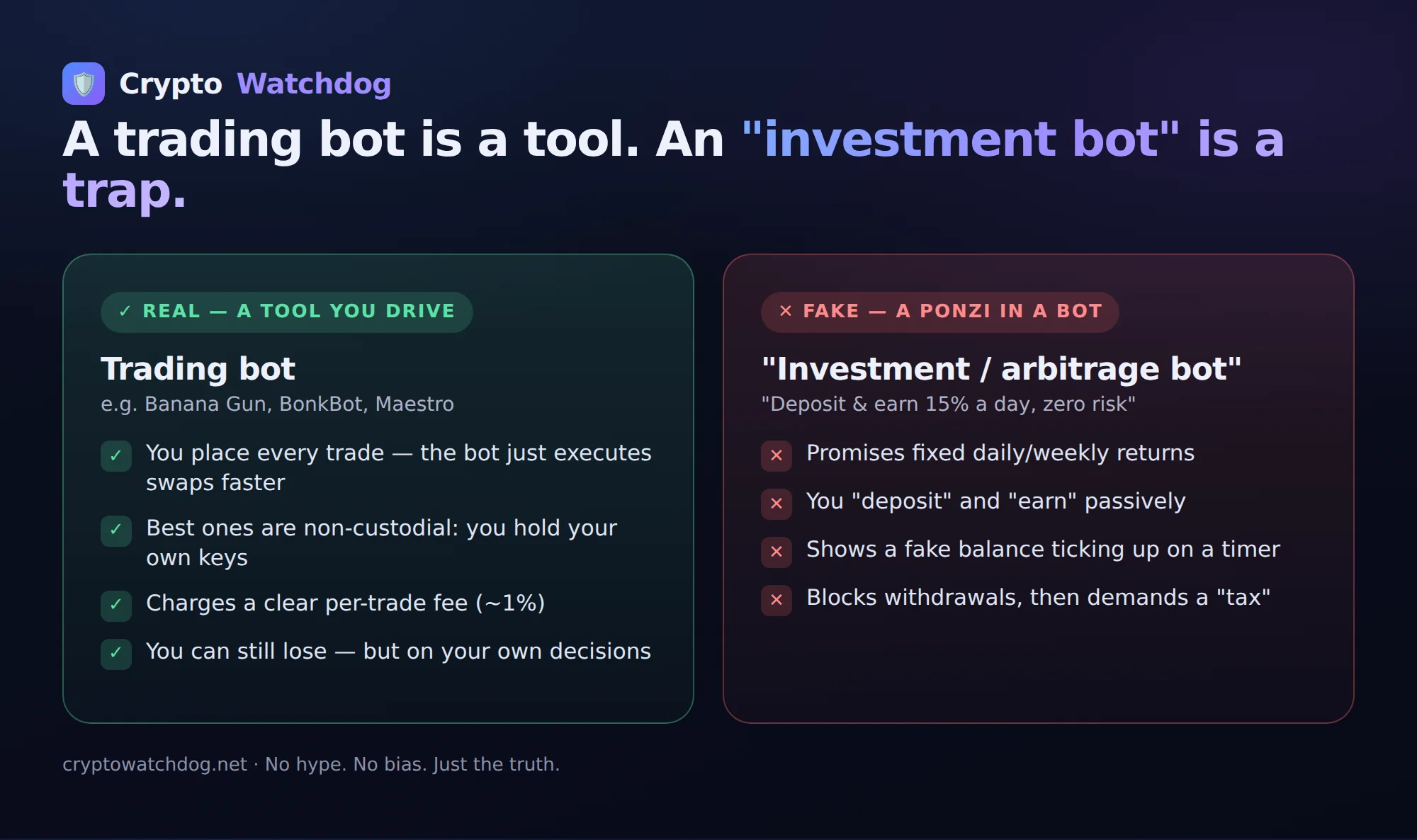
A trading bot is a tool you drive. You connect it, you decide what to buy and sell, and it just executes those swaps faster than you could by hand — sniping a new token launch, setting a stop-loss, copying a wallet. The good ones are non-custodial, meaning your keys never leave your control. You can absolutely still lose money, but you lose it on your own decisions, the same way you would on any exchange.
An "investment bot" (sometimes dressed up as an "arbitrage bot", "AI bot" or "quant bot") is the opposite. It asks you to hand over money and then earn passively — "deposit 500 USDT, watch it grow 15% a day, withdraw whenever you like." There is no real trading behind it. It is a Ponzi scheme wearing a chatbot's clothes, and it ends the same way every single time.
Hold onto that distinction, because scammers work hard to blur it. They borrow the language and screenshots of legitimate tools to make a deposit-and-earn Ponzi look like harmless automation.
How a Telegram investment-bot scam actually works
Almost every version follows the same five-step script. Recognise the pattern once and you will spot it instantly the next time.
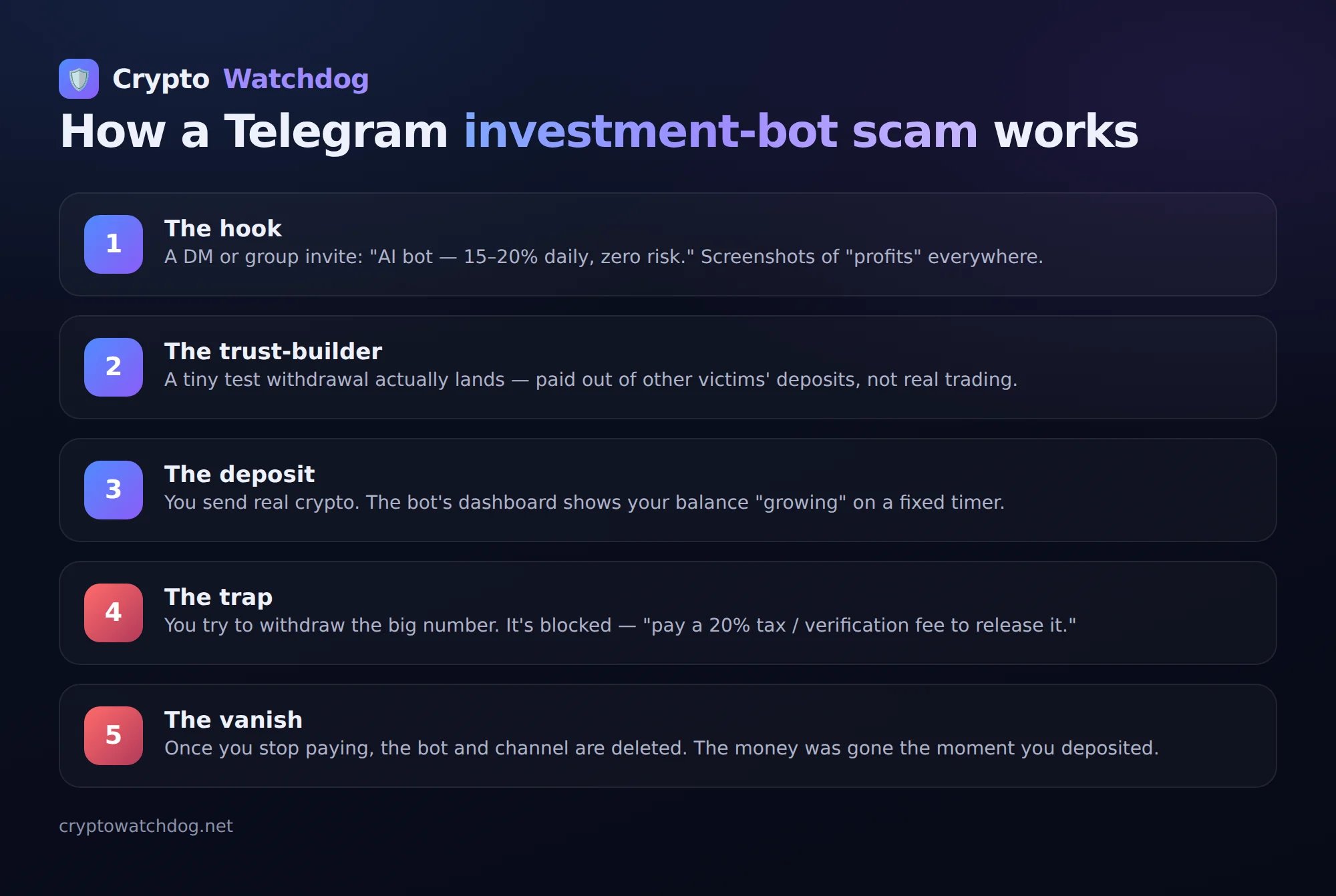
- The hook. You get a direct message, or you are added to a group, promoting a bot that "makes 15–20% a day with zero risk" using AI or arbitrage. The channel is full of glossy screenshots and members posting "withdrawal proof."
- The trust-builder. You are encouraged to start small. A tiny test withdrawal actually lands in your wallet. This is the hook that sets. That payout did not come from trading — it came from the deposits of other victims.
- The deposit. Reassured, you send a real amount. The bot's dashboard shows your balance climbing on a fixed timer. It looks live. It is a number in a database, nothing more; your crypto was moved to the operator's wallet the moment it arrived.
- The trap. You try to withdraw the big number. It is blocked. Now the bot demands a "withdrawal tax", "verification fee" or "gas top-up" — often 20% of the balance — before it will "release" your funds. This is a second theft, not a real fee.
- The vanish. Once you stop paying, the bot and its channel are deleted, the admins block you, and the operators move on to the next batch. The 2025 "GoldenDuck" auto-trading bot is a textbook example — a secretive "quant fund", an "AI algorithm", 15–20% daily "with zero risk", and a mentor who eventually disappeared. (Coinmonks case study)
The demand for a fee before you can withdraw is the tell. No legitimate platform on earth asks you to pay money in order to take your own money out. Paying it never unlocks anything — it just funds the scam.
Why this is worth taking seriously
This is not a fringe problem. According to Chainalysis, total crypto fraud losses reached an estimated $17 billion in 2025, up from $12 billion in 2024, and the average amount lost per scam payment jumped 253% year-on-year to roughly $2,764. (reported via Kaspersky's 2025 Telegram scam analysis) Telegram is a favourite venue precisely because anyone can spin up a professional-looking bot in an afternoon, there is no regulator to answer to, and the global, pseudonymous nature of it makes recovery extremely hard.
It also poisons the well for the real tools. Because "Telegram trading bot" now carries a whiff of fraud, plenty of people either avoid genuinely useful software or, worse, can't tell the two apart and walk straight into the fake.
8 red flags — spot the scam in seconds
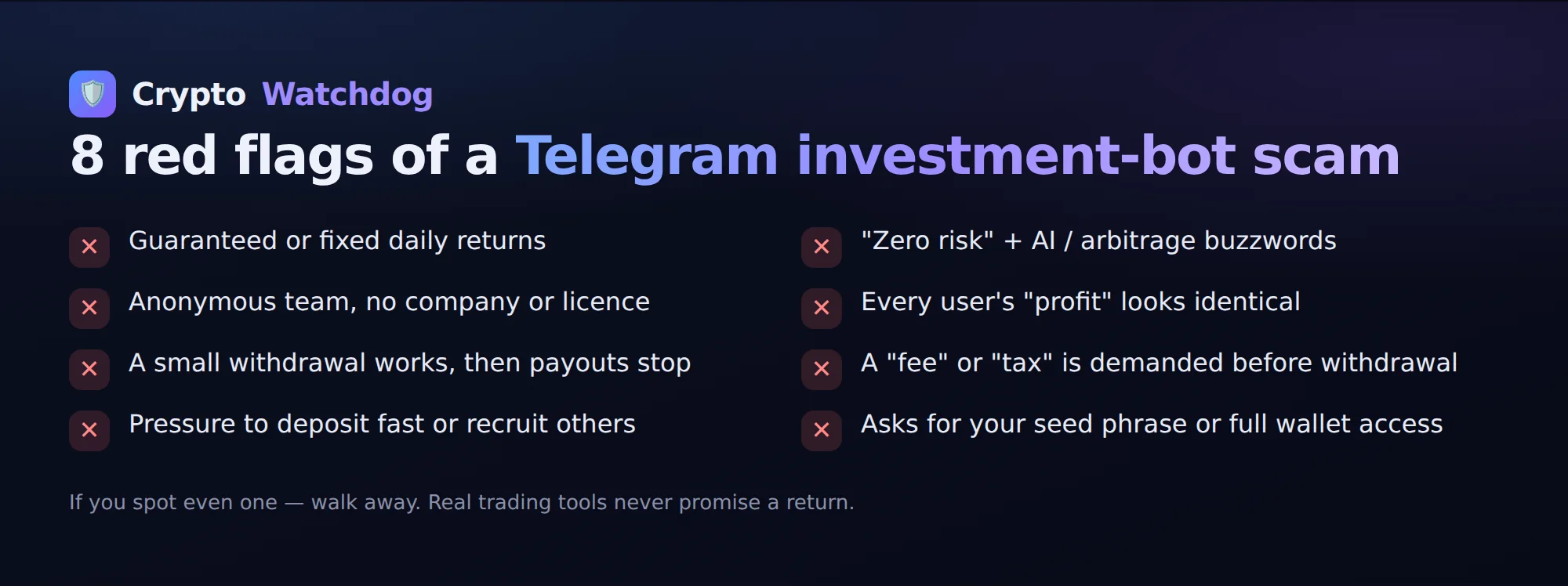
- Guaranteed or fixed daily/weekly returns. Markets move; nobody can promise a number. This alone is disqualifying.
- "Zero risk" plus AI / arbitrage / neural-network buzzwords used to explain the impossible returns.
- An anonymous team with no registered company, no licence, no named humans, and no verifiable track record.
- Everyone's "profit" looks identical and ticks up on a timer — a real strategy produces different results for different people.
- A small withdrawal works, then payouts stop the moment you deposit a serious amount.
- A "fee" or "tax" is demanded before a withdrawal will be released.
- Pressure to act fast ("the investment window is closing") or to recruit others to earn — that is a Ponzi/MLM structure, not a trading tool.
- It asks for your seed phrase or full wallet access. No legitimate bot ever needs your recovery phrase. Handing it over is game over — they can drain everything.
If you can tick even one of these, stop. You can also run any platform past our free 60-second assessment and we'll tell you what we think before you risk a penny.
So are any Telegram bots legit?
Yes — but they are trading tools, not investment products, and even the good ones carry real risk. The most-used bots by lifetime volume are Trojan, BONKbot, Maestro, Banana Gun and SolTradingBot. (CoinGecko's roundup) These genuinely let you snipe and swap tokens from inside Telegram. The catch is that giving any bot the ability to trade means giving it access to a wallet — and that access can be abused or breached:
- Custodial vs non-custodial matters. Non-custodial bots (e.g. Banana Gun, BonkBot) generate keys you control. Custodial bots (e.g. Maestro) hold your keys on their infrastructure so they can sign instantly — convenient, but if their signing service is ever compromised, every wallet is exposed at once. (security comparison)
- Even the big names get hit. Banana Gun suffered a Telegram-oracle exploit in September 2024 that drained around $3M from 11 actively-trading wallets. To its credit, it patched the bug, added 2FA and a transfer delay, brought in external auditors, and reimbursed every affected user in full. (Altcoin Buzz report)
Golden rule if you use any trading bot: fund a fresh burner wallet with only what you're willing to lose, and never connect your main wallet. That single habit contains the damage if a bot is ever exploited.
The CryptoWatchdog Telegram bot directory
This is our running list, sorted into three tiers. Inclusion in the "real tools" tier is not an endorsement — it means the software genuinely exists and does what it claims, not that it's safe for you specifically. We expand this as we verify more; spotted one we're missing? Report a bot.
✅ Real trading tools (genuine software — not investments)
| Bot | Chains | Custody | Our note |
|---|---|---|---|
| Banana Gun | Ethereum, Solana, Base | Non-custodial | Established sniping/trading bot, ~1% fee. Survived a Sept-2024 exploit; patched and reimbursed users. Never promises returns. |
| BonkBot | Solana | Non-custodial | Popular Solana trading bot, flat 1% per trade, no "deposit to earn". You place every trade. |
⚠️ Use with extra caution (custodial or higher-risk)
| Bot | Chains | Custody | Why caution |
|---|---|---|---|
| Maestro | Multi-chain | Custodial | Real, feature-rich bot, but it holds your keys — a breach of its signing service risks all wallets at once. Burner wallet only. |
🚩 Avoid entirely — the scam pattern
| What it looks like | Verdict | Why |
|---|---|---|
| Any "investment", "arbitrage" or "AI" bot that takes a deposit and promises daily/weekly profit | Scam — 100% of the time | Fake balance, blocked withdrawals, a "tax" to release funds. Reported example: "GoldenDuck" auto-trading bot. |
This directory is a work in progress. As readers submit bots and we complete reviews, we'll add named entries with links to full write-ups here and in our scam warnings and platform reviews.
How we sort bots into each tier
We don't guess. A bot lands in ✅ Real tools only when it is verifiably non-investment software (you initiate trades), ideally non-custodial, with a public team or credible track record. It lands in ⚠️ Caution when it's a real tool but custodial, newer, or carrying a known incident. It lands in 🚩 Avoid the instant it promises a return on a deposit, hides its operators, or demands a fee to withdraw. When something sits on the fence, we say so rather than pretend to certainty.
If you've already deposited
- Stop paying immediately. Every "tax", "fee" or "unlock" payment is another theft. More money will not free the balance — that balance was never real.
- Cut contact with the bot admins and leave the group so you're not re-targeted.
- Revoke wallet permissions if you connected a wallet or approved any contract — a tool like Revoke.cash shows what you've authorised.
- Document everything: the bot handle, channel link, transaction IDs and screenshots of the chat. This is what any investigation needs.
- Report it. In the UK, contact Action Fraud; elsewhere, your national fraud line. Then tell us so we can warn others and add the bot to this directory.
Frequently asked questions
Can a Telegram bot really "trade for me" and pay daily? No. A trading bot executes your orders; it cannot guarantee a profit, and any bot advertising fixed daily returns on a deposit is a Ponzi.
A small withdrawal worked — doesn't that prove it's real? No — that's the bait. Early micro-payouts come from other victims' deposits and exist purely to convince you to send more.
They're asking for a fee to withdraw. Should I pay it to get my money? Never. No legitimate platform charges you to remove your own funds. The fee is the scam collecting a second time.
Are Banana Gun / BonkBot / Maestro safe, then? They're real tools, not safe by default. They carry custodial and smart-contract risk, and some have been exploited. Use a burner wallet and only risk what you can afford to lose.
Someone in a group vouched for the bot — that helps, right? Assume paid or fake. Filling channels with fake "withdrawal proof" and shills is part of the playbook.
Sources & further reading: Chainalysis / Kaspersky 2025 scam figures, GoldenDuck case study (Coinmonks), CoinGecko: top Telegram trading bots, TechBullion: bot security comparison, Altcoin Buzz: Banana Gun exploit. This is independent research and education, not financial advice.